


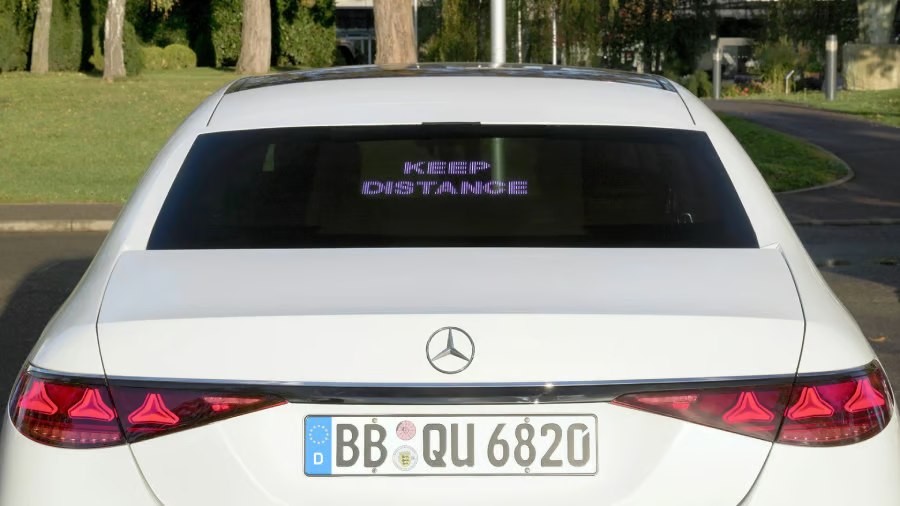
Mercedes-Benz wants its cars to communicate with pedestrians and other drivers through their windows, potentially turning ordinary vehicle glass into another tool for road safety.
The automaker is developing a technology called Intelligent Display in Glass, which integrates LED elements into vehicle windows to show warning symbols, traffic information, and other visual alerts. The LEDs are designed to become nearly invisible when switched off, preserving the glass’s conventional appearance.
Mercedes is also exploring a holographic display that could show different information to drivers and passengers. Neither technology has a confirmed production release date, and questions remain about how the displays would perform under real-world driving conditions.
How Mercedes’ new screen tech would work
Mercedes-Benz is exploring two types of LEDs for its Intelligent Display in Glass technology. Mini LEDs could support larger display areas, such as rear windows, while micro LEDs could provide more detailed graphics in smaller sections of glass.
The LEDs are integrated into the windows and designed to remain nearly invisible when switched off. When activated, they could display information visible to people inside or outside the vehicle, including warning symbols and other visual alerts.
Mercedes is also developing a Holographic Display that uses a dashboard-mounted projector and a transparent film containing holographic optical elements to direct images toward specific viewing positions inside the vehicle.
The system is designed to show different content to the driver and passenger. For example, the driver could receive navigation guidance while the passenger views entertainment content without both occupants seeing the same display.
Unlike Intelligent Display in Glass, which could communicate information to people outside the vehicle, the holographic system focuses on how information is presented to occupants inside the cabin.
The two technologies could also serve different purposes beyond entertainment. While the holographic display could reduce the need for separate dashboard screens, Intelligent Display in Glass could let vehicles communicate with other road users through warning symbols, pedestrian alerts, and traffic information displayed on their windows.
What's hot at TechRepublic
- Blackpoint Cyber vs. Arctic Wolf: Which MDR Solution is Right for You?
- Why AWS Sellers Choose Deepgram Over Other Voice AI Tools
- SS&C Intralinks DealCentre AI vs. Datasite: Which platform is built for the future of dealmaking?
- SS&C Intralinks FundCentre AI vs. Juniper Square: Which platform better supports modern private markets fund managers?
- Verito vs. Rightworks: Which IT Provider Is Best for Your Firm?
The tech faces a regulatory test ahead
Before Mercedes can bring display-equipped windows to production vehicles, it may need to address regulatory requirements governing visibility, vehicle lighting, and external signals.
The idea also has implications for driverless technology. Autonomous vehicles will need ways to communicate their intentions to pedestrians, cyclists, and other road users, especially when there is no human driver to make eye contact or signals. Display-equipped windows could provide another channel for such communication, although Mercedes has not specifically announced this as an application of its technology.
However, getting such displays onto production vehicles may not be straightforward. Vehicle windows must meet safety and visibility requirements, while external lighting and signaling devices are subject to rules governing their permitted functions and appearance. Several regional and state rules can further complicate this, making technology availability uneven.
Mercedes will therefore need to establish not only that its displays work, but also that their use meets applicable vehicle approval requirements and communicates information without confusing or distracting other road users.
What drivers should watch for next
For drivers and prospective Mercedes buyers, the biggest thing to watch is whether these technologies make it into production vehicles and how much they improve the driving experience. A windshield that doubles as a display could reduce dependence on dashboard screens, while LED-equipped windows could give vehicles new ways to communicate safety information to pedestrians and other road users.
However, image quality, visibility, reliability, production costs, and regulatory approval will determine how practical these systems become. Mercedes has demonstrated the underlying technology, but it still needs to address some of the limitations observed in its holographic display prototype.
For now, the bigger question is whether Mercedes can turn these experiments into commercially viable features without compromising the basic functions of vehicle glass: visibility, safety, and driver attention. If the company successfully does so, it may become a pacesetter for other automakers, effectively making the tech a standard part of the driving experience.
In other news, Samsung has secured regulatory approval in South Korea for hearing test and hearing aid features on its Galaxy Buds4 Pro and Buds3 Pro, allowing adults with mild to moderate hearing loss to receive personalized sound amplification through software updates beginning in early 2027.