


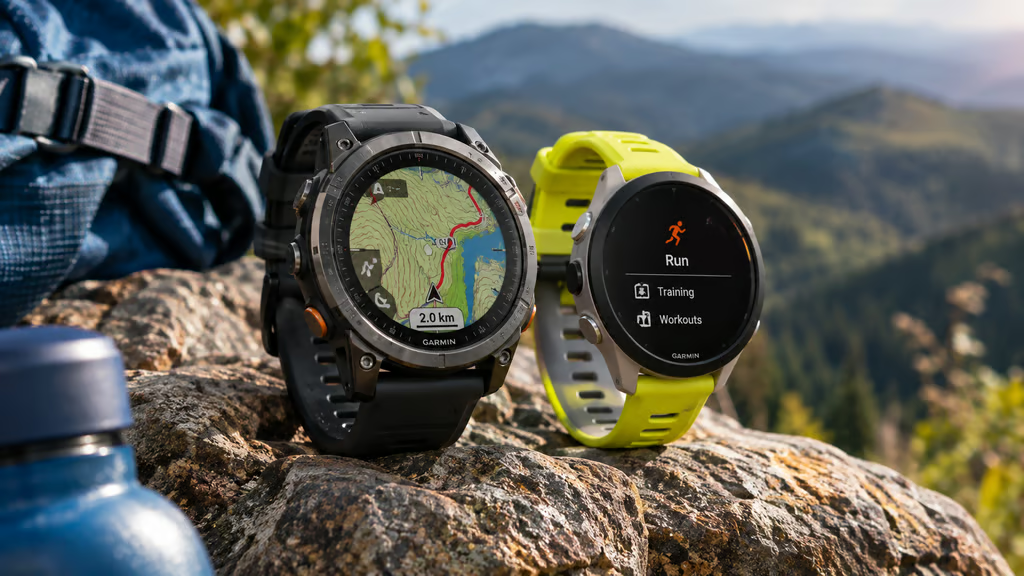
The Garmin Forerunner 970 costs $749.99. The fēnix 9 starts at $999.99. That’s an extra $250 for a watch that won’t necessarily make you a better runner.
Both offer detailed training metrics, multi-band GPS, built-in maps, and an LED flashlight. The difference becomes clearer when you leave the running track. The fēnix 9 offers tougher construction, more case sizes, and longer battery options, while select fēnix 9 Pro models add satellite communication.
The Forerunner 970 is the better choice for most runners and triathletes. The fēnix 9 earns its premium for people who regularly hike, dive, or need a watch built for extended outdoor adventures.
- Garmin Fenix 9 vs Forerunner 970: At a glance
- Garmin Fenix 9 vs Forerunner 970: Specs compared
- How we compared
- Running and triathlon training: The Forerunner 970 has the advantage
- GPS and heart-rate accuracy: Both are excellent
- Maps and navigation: The Fenix 9 offers more
- Battery life: The Fenix 9 wins, but size matters
- Comfort and durability: Lighter or tougher?
- Satellite connectivity: Know which Fenix you’re buying
- Price and value: The Forerunner 970 makes more sense for most people
- Garmin Fenix 9 vs Forerunner 970: Which should you buy?
Garmin Fenix 9 vs Forerunner 970: At a glance
- Best for running: Forerunner 970, with race-focused training features and a lighter design.
- Best for hiking: fēnix 9, with rugged construction and upgraded navigation.
- Best battery life: fēnix 9, particularly the larger and solar-equipped configurations.
- Best GPS accuracy: Tie. Independent testing found both highly capable.
- Best value: Forerunner 970, starting $250 below the standard fēnix 9.
- Best for satellite SOS: Select fēnix 9 Pro inReach models, with an active subscription and coverage limitations.
Garmin Fenix 9 vs Forerunner 970: Specs compared
| Feature | Garmin Forerunner 970 | Garmin fēnix 9 | Garmin fēnix 9 Pro |
|---|---|---|---|
| US starting MSRP | $749.99 | $999.99 | $1,099.99 |
| Case sizes | 47mm | 43mm, 47mm, 51mm | 43mm, 47mm, 51mm |
| Display | AMOLED | AMOLED | AMOLED; solar options |
| Lens | Sapphire crystal | Sapphire | Sapphire |
| Construction | Titanium bezel, polymer case | Titanium bezel, polymer center case | Titanium case |
| Rated smartwatch battery | Up to 15 days | Up to 29 days, 51mm | Up to 31 days AMOLED; up to 57 days with solar, select 51mm models |
| Multi-band GPS | ✔ | ✔ | ✔ |
| Built-in maps | ✔ | ✔ | ✔ |
| LED flashlight | ✔ | ✔ | ✔ |
| Running tolerance | ✔ | Not confirmed | Not confirmed |
| Running economy | ✔, requires compatible HRM 600 | Not confirmed | Not confirmed |
| Water resistance | 5 ATM | 10 ATM | 10 ATM |
| Diving support | Not advertised | Dive-rated to 40m | Dive-rated to 40m |
| Satellite SOS | ✖ | ✖ | ✔, select inReach configurations only |
Prices are published US launch MSRPs, not verified current discounts. The $1,099.99 Pro starting price does not include every premium feature or an inReach-equipped configuration. Battery estimates vary by size, display, settings, and activity.
How we compared
We used Garmin’s official product specifications and launch announcements to verify prices, sizes, training features, battery ratings, and connectivity.
For independent evidence, we reviewed DC Rainmaker’s hands-on testing of both watches and Tom’s Guide’s direct comparison during a half marathon. We also considered longer-term Forerunner 970 testing from Android Central and iRunFar.
No original testing was conducted for this article. We distinguish manufacturer claims from measured results and avoid treating tests of different case sizes or configurations as directly interchangeable.
Our assessment prioritizes running features, tracking accuracy, navigation, battery life, comfort, durability, and the cost of optional hardware and connectivity.
Running and triathlon training: The Forerunner 970 has the advantage
The Forerunner 970 has a clear identity: it’s built for people who care about their next race.
Garmin’s Forerunner 970 announcement introduced running tolerance, which estimates training impact and recommends a weekly mileage limit.
It also offers automatic lap timing based on course markers and projected race performance.
Two advanced metrics require additional hardware. Running economy and step speed loss need Garmin’s separately sold HRM 600 chest strap, so the watch’s $749.99 starting price doesn’t include every measurement.
The Forerunner’s training features have also received independent scrutiny.
DC Rainmaker tested the watch across multiple activities, examining running tolerance, GPS accuracy, heart-rate tracking, and battery consumption.
Android Central’s monthlong testing found reliable GPS and heart-rate performance, while iRunFar praised the watch after four months of use.
The fēnix 9 isn’t short on training tools. Garmin added stamina zones and stamina curve, giving athletes more ways to assess endurance and pacing.
However, Garmin’s running-watch materials specifically associate running tolerance and running economy with the Forerunner 970. Those features shouldn’t be assumed available on the fēnix 9.
Garmin also delivers new running tools through software updates, so checking current feature availability is worthwhile before buying.
Winner: Forerunner 970.
GPS and heart-rate accuracy: Both are excellent
Paying more doesn’t automatically buy more accurate tracking.
Tom’s Guide tested the fēnix 9 Pro and Forerunner 970 together during a half marathon, using a chest strap as a heart-rate reference.
Both watches tracked closely with the strap throughout the race, although the fēnix 9 Pro briefly recorded an erroneous spike near the start.
The reviewer also reported consistently strong GPS performance after extensive use of both watches.
DC Rainmaker’s separate testing likewise found generally reliable GPS and optical heart-rate measurements across running, cycling, and other activities.
That doesn’t establish identical performance in every environment. Dense buildings, difficult terrain, watch fit, and exercise type can affect readings.
But there’s no compelling independent evidence here that spending another $250 on the fēnix 9 will give most runners meaningfully better GPS or heart-rate data.
Winner: Tie.
Maps and navigation: The Fenix 9 offers more
Both watches can display detailed maps and provide turn-by-turn navigation.
The Forerunner 970 is already well equipped for trail running, unfamiliar race routes, and weekend hikes.
The fēnix 9 adds Garmin’s updated map engine and a perspective view designed to make terrain easier to understand.
According to Garmin’s fēnix 9 announcement, the watch has 50% more RAM than the fēnix 8 and can pan maps up to 30% faster.
That’s Garmin’s comparison with the previous fēnix generation, not a measured speed advantage over the Forerunner 970.
The improved mapping hardware is appealing, but early independent reviews also reported software crashes and occasional map freezes.
For most runs, the Forerunner’s navigation is sufficient. The fēnix becomes more attractive when you’re regularly planning longer routes or navigating unfamiliar terrain.
Winner: fēnix 9.
Battery life: The Fenix 9 wins, but size matters
The Forerunner 970 offers up to 15 days of smartwatch battery life, according to Garmin.
The standard fēnix 9 reaches up to 29 days in its largest 51mm configuration. The 51mm Pro AMOLED is rated for up to 31 days.
Garmin’s 51mm Pro Solar models can reach up to 57 days under specified conditions, including all-day wear and three hours outdoors daily in strong sunlight.
Those figures sound impressive, but they’re maximum manufacturer estimates.
The smaller fēnix models don’t last nearly as long. Garmin rates the 43mm fēnix 9 for up to 10 days, less than the Forerunner 970’s stated maximum.
Independent testing provides useful context.
In Tom’s Guide’s direct comparison, the reviewer typically got four to five days from the Forerunner 970 with its always-on display and daily outdoor runs.
The 51mm fēnix 9 Pro lasted roughly 10 to 11 days under similar usage.
That is a substantial difference, although it compares the largest fēnix Pro against a smaller running watch.
For everyday training, the Forerunner’s endurance should be sufficient for many buyers. For multiday adventures, the larger fēnix configurations offer a clear advantage.
Winner: fēnix 9, depending on configuration.
Comfort and durability: Lighter or tougher?
The Forerunner 970 weighs approximately 56g, making it comfortable for running, sleeping, and everyday wear.
Its sapphire crystal lens and titanium bezel also mean you’re not giving up premium materials to save money.
The fēnix 9 takes durability further.
Garmin gives it 10 ATM water resistance, leakproof buttons, and a dive rating of 40 meters. The standard model uses a titanium bezel, while Pro models add a titanium case.
That tougher construction can be useful for demanding outdoor activities, but larger watches aren’t always more comfortable.
A bulky case may feel less convenient during sleep or long runs. The Forerunner’s lighter design is easier to forget you’re wearing.
For runners, that matters. For divers and outdoor adventurers, the fēnix’s additional protection may justify the trade-off.
Winner: Forerunner 970 for comfort; fēnix 9 for durability.
Satellite connectivity: Know which Fenix you’re buying
The standard fēnix 9 doesn’t include satellite SOS. Neither does the Forerunner 970.
Garmin reserves phone-free satellite messaging and emergency assistance for select fēnix 9 Pro inReach configurations.
Even then, an active subscription is required, and service availability depends on location.
The distinction between satellite and LTE connectivity also matters.
Supported LTE features can provide calling and messaging through Garmin’s services where compatible network coverage exists. Satellite connectivity supports functions such as messaging, check-ins, and interactive SOS, but not ordinary cellular voice calls.
Garmin warns that the watch’s satellite capabilities have limitations compared with dedicated inReach devices.
If emergency communication is your main reason for upgrading, verify coverage for your intended destination before purchasing.
The fēnix 9 Pro also offers brighter AMOLED displays, solar options, and additional case choices. But those features aren’t all included in the base Pro price.
Winner: fēnix 9 Pro inReach, for supported off-grid communication.
Price and value: The Forerunner 970 makes more sense for most people
The Forerunner 970 starts at $749.99, compared with $999.99 for the fēnix 9.
The $250 difference buys outdoor-focused hardware and configuration flexibility, not a guaranteed improvement in core running accuracy.
The fēnix 9 Pro starts at $1,099.99, but selecting an inReach-equipped version raises the price further. An active service plan adds an ongoing cost.
For a runner who wants advanced training metrics, dependable tracking, maps, and a comfortable watch, the Forerunner 970 already delivers.
Both models also offer health features beyond sports tracking, including ECG functionality in supported regions.
Availability isn’t universal. Garmin’s recent ECG expansion in India illustrates why buyers should verify regional eligibility rather than assume every advertised feature works everywhere.
If you primarily train on roads, tracks, and familiar trails, the Forerunner is the easier purchase to justify.
Winner: Forerunner 970.
Garmin Fenix 9 vs Forerunner 970: Which should you buy?
Buy the Forerunner 970 if you:
- Primarily run, race, or train for triathlons.
- Want advanced training and recovery insights.
- Prefer a lighter watch for daily wear.
- Need accurate GPS, heart-rate tracking, and maps.
- Want to save at least $250 compared with the base fēnix 9.
Buy the fēnix 9 if you:
- Regularly hike, dive, or spend extended time outdoors.
- Want a choice of case sizes and longer battery options.
- Value rugged construction and upgraded navigation.
- Need a watch suited to demanding outdoor activities.
- Are comfortable paying more for those capabilities.
Consider a fēnix 9 Pro inReach model if you specifically need supported satellite messaging or emergency assistance without a phone. Check the configuration, coverage, and subscription requirements first.
Final verdict
The Forerunner 970 is the better buy for most runners and triathletes. It’s lighter, costs $250 less, and delivers the training features and tracking accuracy that matter most for racing and everyday workouts.
The fēnix 9 earns its higher price when your activities demand tougher hardware, longer battery life, or more advanced outdoor navigation.
Neither is an automatic upgrade for someone who already owns a recent premium Garmin. Before replacing a working watch, check whether a software update has added the feature you want.
Also read: The fēnix 9 Pro upgrades include a titanium case, brighter display options, and access to inReach configurations, but not every Pro model has satellite connectivity.