
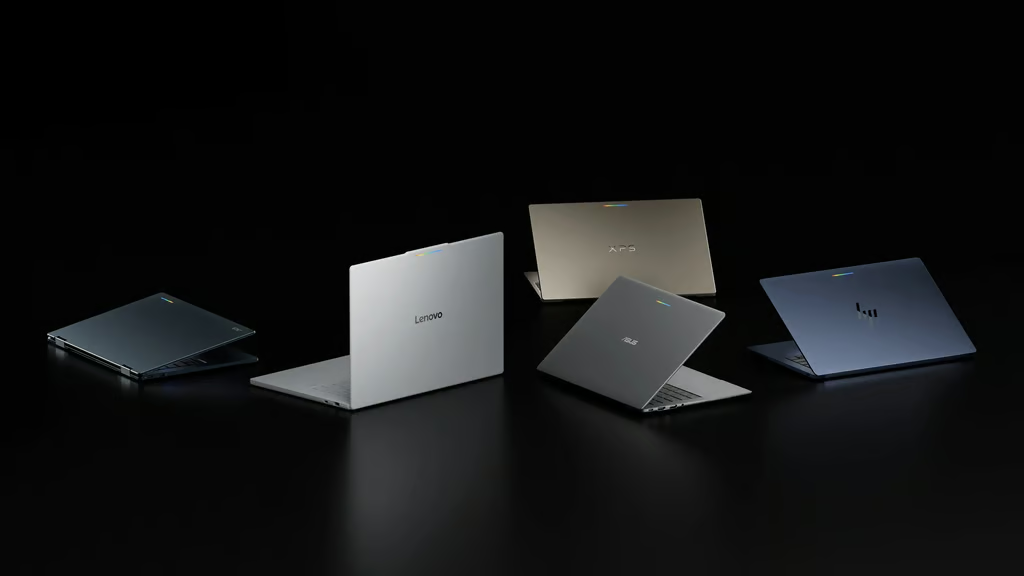


Googlebook is no longer just Google’s pitch for an Android-powered laptop. Five models are now up for preorder, with a $400 gap separating the cheapest and most expensive machines.
Google opened preorders Sept. 21 for laptops from Acer, ASUS, Dell, HP, and Lenovo, with current US starting prices ranging from $899 to $1,299. All five run Google’s new Android-based laptop platform, but differences in screen size, processor architecture, weight, battery estimates, and form factor give buyers substantially different options.
The laptops reach US stores Oct. 4, followed by Canada, the UK, Ireland, France, Germany, and Australia on Oct. 5, according to Google’s launch and preorder announcement.
How the five Googlebooks differ
Google’s current US comparison lists these base configurations:
| Model | Starting price | Processor | Display | Battery | Weight |
| Acer Googlebook 14 | $899 | Intel Core Ultra 5 | 14-inch 2.8K OLED | Up to 16 hours | 2.51 lb |
| XPS Googlebook | $999 | Snapdragon X Elite | 13.4-inch 2.5K LCD | Up to 18 hours | 2.2 lb |
| Lenovo Googlebook 15 | $1,099 | Intel Core Ultra 5 | 15.3-inch 2.8K OLED | Up to 13 hours | 2.84 lb |
| ASUS Googlebook 14 | $1,299 | Intel Core Ultra 5 | 14-inch 2.8K OLED | Up to 16 hours | 2.2 lb |
| HP Googlebook 14 | $1,299 | Snapdragon X Elite | 14-inch 2.8K OLED | Up to 19 hours | 2.74 lb |
How we compared them: We used Google’s current US pricing and specifications for all five launch models, focusing on the differences most likely to affect a buying decision: price, processor, display, weight, form factor, and claimed battery life.
Google says its battery estimates come from controlled web-browsing tests, so actual runtime will vary with settings, network conditions, and use.
The Acer Googlebook 14 is currently the cheapest model and the only convertible 2-in-1 in the launch lineup, according to The Verge’s hands-on overview. Acer also told the publication that $899 is an initial launch price that could be reevaluated as component costs change.
Dell’s XPS Googlebook and the ASUS Googlebook 14 are the lightest listed models at 2.2 pounds. Dell combines that weight with Snapdragon X Elite and an 18-hour battery estimate, while ASUS offers a larger OLED display at a $300 premium.
Lenovo’s $1,099 Googlebook 15 has the largest screen at 15.3 inches but the shortest battery estimate, at 13 hours. HP goes the other direction: its $1,299 Googlebook 14 carries Google’s longest estimate at 19 hours and supports face and fingerprint unlocking.
Googlebook brings Android deeper into laptops
Google first previewed Googlebook on May 12, positioning it as a new category rather than a Chromebook rebrand. TechRepublic previously examined how Googlebook differs from Chromebook, including its tighter Android integration and phone connectivity.
The platform combines an Android technology stack with desktop foundations developed through ChromeOS, including a desktop-class Chrome browser, Android apps, and Linux development tools. Some cross-device features, including Cast My Apps and Quick Access, require a paired Android phone running Android 17 or later.
Organizations considering Googlebook should still verify application compatibility, device management, and security requirements before treating it as a direct Windows or macOS replacement. Google’s newer Android security-state tools also show how enterprise Android management is becoming more granular.
Price, screen size, display type, and Google’s battery estimates already separate the five launch models. Real-world performance, thermals, battery life, and workload-specific differences between Intel and Snapdragon remain the biggest unknowns as independent testing begins.
Also read: If you’re comparing premium laptops more broadly, see TechRepublic’s latest laptop buying guides and comparisons for current alternatives across Windows, ChromeOS, and other platforms.