


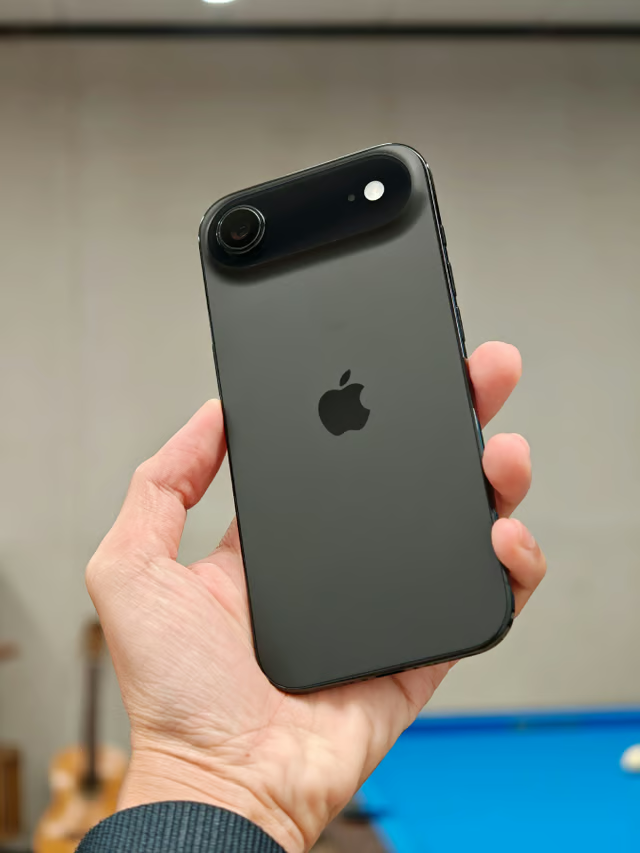
Apple aims to prove that an impossibly slim smartphone doesn’t have to die before dinner.
Weibo-based leaker Digital Chat Station reported that Apple is preparing a battery boost for the second-generation iPhone Air, with supply chain rumors pointing to a 3,500mAh battery. That would be an increase from the 3,149mAh battery inside the current iPhone Air, representing roughly an 11% capacity jump.
Digital Chat Station also claimed that the iPhone Air 2 will combine the larger battery with Apple’s next-generation A20 chip, a 6.55-inch 120Hz display, a dual-camera system and Face ID.
Apple faces a difficult engineering challenge
Adding battery capacity sounds straightforward, but ultra-thin phones leave little room for internal changes. The current iPhone Air reportedly uses a compact internal layout designed around maximizing battery space within a slim chassis.
MacRumors noted that Apple would likely need to redesign the iPhone Air 2’s internal layout because the device is also expected to gain a second rear camera. The rumored upgrade would add an ultra-wide lens alongside the existing 48-megapixel main camera, addressing one of the biggest criticisms of the first-generation model.
Apple could potentially create more space through more efficient internal packaging, higher-density battery technology, or a thinner display design. Reports suggest the company may use Samsung’s Color Filter on Encapsulation (CoE) OLED technology, which could reduce display thickness and free up additional room.
Efficiency improvements could matter as much as battery size
The larger battery may only be part of Apple’s strategy. The iPhone Air 2 is also expected to use the A20 chip built on a 2nm manufacturing process, which could improve power efficiency compared with the current generation.
According to a supply chain leak, the battery upgrade could help push the device beyond the current model’s endurance rating, potentially reaching around 30 hours of offline video playback if combined with efficiency improvements.
However, battery capacity alone does not guarantee dramatically longer real-world usage. Display brightness, software optimization, network performance, and camera use all affect how long a phone lasts in everyday conditions.
Must-read Apple coverage
- Nearly 7 in 10 iPhone Owners Plan iPhone 17 Upgrade
- Apple Prepares AI-Powered Siri Upgrade With Google Search Integration
- Apple’s Xcode 26 Beta Now Supports GPT-5 and Claude
- Apple’s Vision Pro Adoption Stalled As Content Released ‘Drip by Drip’
Why this could matter for future iPhones
The iPhone Air represents Apple’s attempt to make ultra-thin phones more mainstream, but battery concerns remain the biggest tradeoff with slimmer designs. A larger battery combined with a more efficient processor would help Apple prove that thin phones do not have to sacrifice endurance.
The addition of a second camera could also make the Air lineup more appealing to buyers who previously chose standard iPhone models because of better photography flexibility. At the same time, Apple has a narrow path to follow. A bigger battery, extra camera hardware, and new components all compete for limited internal space. Keeping the same thin profile while adding these upgrades would be a major design challenge.
The iPhone Air 2 is currently rumored to launch in the first half of 2027 alongside the iPhone 18 and iPhone 18e lineup. If the reports are accurate, Apple’s next ultra-thin iPhone could focus less on being simply the thinnest device and more on delivering a balanced flagship experience.
In other news: Rising DRAM and NAND prices could make Android phones more expensive or less capable. Learn what the changes could mean for buyers.