
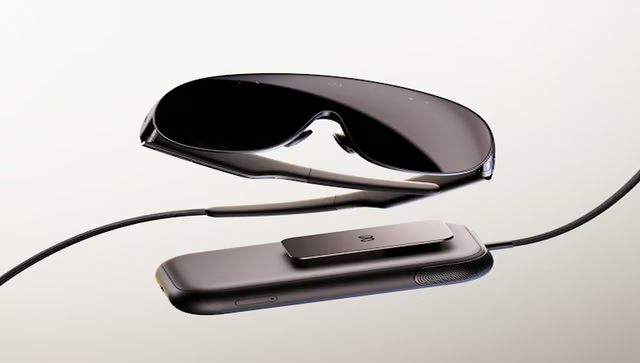


Meta is trying to make virtual reality lighter by moving much of the computer off your head.
The company unveiled Meta VR Glasses at Meta Connect on Sept. 23, a $1,299.99 mixed-reality device built around high-resolution displays, eye and hand tracking, Meta AI, and virtual desktop features. The device is expected to arrive in spring 2027.
Rather than packing the processor, battery, and storage into the headset, Meta has moved those components into a separate 300-gram computing puck connected by an optical cable. The glasses themselves weigh about 100 grams, creating a lighter headset but requiring users to carry a second piece of hardware.
A display designed for work
While many VR devices fall into the gaming headset category, Meta is positioning its VR Glasses a bit differently, as more of a productivity-driven tool.
The device uses Meta’s “5K Infinite Display,” built around micro-OLED panels with a resolution of 2,412 by 2,288 pixels per eye and 37 pixels per degree. The display can run at up to 120Hz, and the glasses include integrated eye tracking and pancake lenses.
Those specifications matter because Meta is pitching the glasses as a portable multi-screen workspace, particularly for workers who need access to multiple screens while traveling. Users can wirelessly connect a Mac, Windows PC, or phone and create a multi-screen virtual workspace.
The glasses also support DisplayPort, letting users connect directly to laptops, consoles, and handheld gaming devices.
While related to the Meta Smart Glasses, the new VR devices will operate more like a full VR and spatial-computing device, with more robust features for these purposes.
Meta is also building a Surface Keyboard feature into the platform, which lets a flat surface function as a virtual keyboard and trackpad. Bluetooth support also lets users connect physical keyboards, gamepads, and other peripherals when they want a more conventional setup.
It’s a simple idea, but an enticing one. For someone working from a hotel room, airplane, or other location where carrying a monitor isn’t practical, the glasses would let them create their own large virtual workspace without taking up real space.
Meta specifically describes the device as a way to create a portable workspace while maintaining visibility of the user’s surroundings through full-color passthrough.
AI and gesture controls replace the traditional interface
Meta is also trying to make interacting with the glasses feel less like using a traditional VR headset, in part by reducing its reliance on physical controllers. The glasses use eye tracking and hand gestures as primary input methods, letting users look at an interface element and use gestures such as pinching or swiping to interact with it.
Touch Plus controllers are supported separately for those who want them, including controllers already owned by Meta Quest 3 and 3S users.
Of course, Meta AI is built into the operating system, allowing users to interact with the device through voice commands as well as their eyes and hands. The company says users can use these controls to open applications, adjust their workspace, play media, and search for information.
The glasses use Qualcomm’s Snapdragon Reality Elite processor and a battery that provides up to three hours of continuous high-resolution media playback. It supports 45W fast charging, including charging while in use.
The device has 12GB of RAM and 128GB of internal storage, with support for up to 1TB of expandable storage through a microSD card.
What's hot at TechRepublic
- Blackpoint Cyber vs. Arctic Wolf: Which MDR Solution is Right for You?
- Why AWS Sellers Choose Deepgram Over Other Voice AI Tools
- SS&C Intralinks DealCentre AI vs. Datasite: Which platform is built for the future of dealmaking?
- SS&C Intralinks FundCentre AI vs. Juniper Square: Which platform better supports modern private markets fund managers?
- Verito vs. Rightworks: Which IT Provider Is Best for Your Firm?
A $1,300 test of whether VR can become everyday computing
Now, don’t think Meta forgot to bring entertainment and gaming to the device. The company is promoting it as a portable cinema, gaming platform and multi-screen computer, with access to the existing Meta Quest software catalog. More than 75 games and apps are expected to support hand-gesture controls at launch.
It will also be interesting to see whether the device’s new design justifies its price, which puts Meta VR Glasses in a different category from the company’s more affordable Quest products. At $1,299.99, Meta VR Glasses aren’t an inexpensive alternative to a conventional monitor or laptop.
Instead, Meta seems to be hoping that users will pay for a combination of private virtual screens, portability, immersive media, and hands-free controls in a device that is substantially lighter than a conventional VR headset.
Meta has not announced an exact launch date beyond spring 2027. Until then, the product remains an early test of whether spatial computing can move beyond entertainment and become a practical everyday workspace.
Other news: Beats has launched its $349.99 Beats 360 headphones with swappable ear and headband cushions, up to 32 hours of battery life, and stronger active noise cancellation than the Studio Pro.