
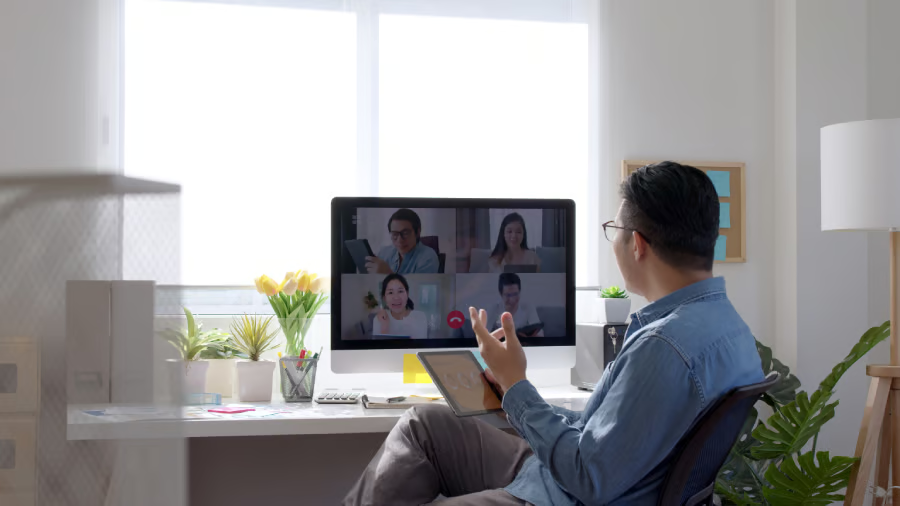


Neat wants meeting rooms to do more than host video calls.
At InfoComm 2026, the company announced new hardware, AI-powered framing features, BYOD-friendly room capabilities, and Neat Pulse MCP, a Model Context Protocol implementation that enables AI agents to act on device, room, sensor, user, and location data in real time. For IT teams, the bigger story is not one new device, but the emergence of meeting rooms that can be monitored, adjusted, and optimized as connected systems.
That shift matters because hybrid work has turned conference rooms into operational pressure points. Rooms need to support remote participants, reduce AV friction, and provide IT and facilities teams with better data on how spaces are actually being used.
What Neat announced at InfoComm
Neat made several announcements at InfoComm.
First up is Neat Pulse MCP, an implementation of the Model Context Protocol that exposes device management, sensor data, rooms, locations, users, and more as tools AI agents can act on in real time. This means an agent can query room utilization, adjust device settings, respond to alerts, and orchestrate workflows across Neat’s portfolio via a standardized interface rather than brittle, bespoke integrations.
On the experience side, Neat is rolling out Intelligent Framing for larger rooms, combining multi-camera setups (for example, Neat Bar Pro with one or two Neat Centers) with real-time AI to track active and previous speakers and stitch together the best view of participants. The aim is to help remote attendees follow the conversation naturally, rather than watching a static wide shot or jarring jump cuts between speakers.
Neat also made its latest hardware generally available: Neat Board 32, a 32-inch all-in-one collaboration touchscreen for small rooms and personal spaces, and Neat Pad Pro, a 10-inch controller/scheduler with upgraded compute and audio capabilities, along with flexible mounting options.
Finally, Neat Open extends the portfolio beyond fixed Zoom, Meet, and Teams room modes to a BYOD-friendly, app-centric experience that keeps rooms useful between scheduled calls while still being managed through Neat Pulse.
Why meeting rooms need a rethink
Most enterprises still live with a bifurcated reality: modern collaboration software at the edge and meeting rooms designed for a world of single-vendor codecs and predictable, in-office attendance patterns.
Hybrid work has exposed every weakness in that model — rooms that are booked but unused, meetings that start late because of AV friction, remote participants who feel like second-class citizens, and IT teams drowning in “this room is broken” tickets.
At the same time, facilities and HR teams are under pressure to justify real estate spend by demonstrating that spaces are used and used effectively. Without instrumentation and automation, most organizations are guessing; they rely on badge data, calendar bookings, or periodic surveys that do not capture how meetings actually unfold or why certain spaces succeed while others fail.
Modernizing meeting spaces is ultimately about three outcomes:
- Making every participant, whether they are remote or in-room, feel equally present
- Reducing operational drag on IT and AV teams
- Turning real estate and device fleets into observable, optimizable systems rather than sunk costs
The Neat announcements are notable because they address all three outcomes at once: AI-driven room management, more inclusive video experiences, and hardware/software designed for flexible usage patterns.
From ‘smart devices’ to agentic rooms
Most current-generation room systems are “smart” only in a narrow sense: they can auto-frame, adjust exposure, or maybe alert when a device goes offline. What Neat is proposing with Pulse MCP is an agentic layer in which AI systems not only observe but also take actions across a fleet, changing configurations, escalating issues, or even shaping the meeting experience itself.
Because Pulse MCP exposes a broad set of tools, including device management, sensor data, rooms, locations, users, profiles, and audit logs, an AI agent can operate with context and accountability. For example, a support agent could correlate chronic audio issues in a single room with specific devices, firmware levels, or occupancy patterns, then roll out targeted fixes across similar spaces.
This is where “thinking rooms” move from marketing to something tangible. A room can notice that its utilization is far below that of peer spaces, correlate that with frequent failures or awkward seating layouts, and surface a recommendation: change the layout, adjust camera presets, or repurpose the space entirely. The heavy lifting, data collection, correlation, and suggested action happen via software agents rather than manual spreadsheet wrangling.
More must-read AI coverage
- SS&C Intralinks DealCentre AI vs. Datasite: Which platform is built for the future of dealmaking?
- SS&C Intralinks FundCentre AI vs. Juniper Square: Which platform better supports modern private markets fund managers?
- Why Data, Not Models, Determines AI Success
- The Rise of the AI-Native Factory: How Physical AI Is Transforming Manufacturing
Intelligent framing and the experience divide
The visual experience still determines whether hybrid meetings feel inclusive.
A single front-of-room camera in a wide shot turns in-room participants into postage stamps and renders side conversations invisible to remote attendees. Neat’s Intelligent Framing aims to address this in large rooms by coordinating multiple cameras and microphones to follow the conversation as it naturally shifts.
In a dual Neat Center configuration with a Neat Bar Pro, up to 48 microphones and 8 cameras can work together to capture a room in 360 degrees, then use AI to select the view that best represents what is happening. Speaker framing can surface both the active and prior speakers simultaneously, replicating the way you naturally look around a physical room rather than snapping instantly from one face to another.
For IT, the nuance here is important: features like Intelligent Framing can be polarizing if they are too aggressive or opaque. The difference between a gimmick and value often comes down to policy and control — tuning framing behaviors by room type, disabling advanced modes when they are not appropriate, and gathering feedback to refine defaults over time. That is where centralized management and an open control plane become as critical as the AI features themselves.
Practical guidance for IT practitioners
For those responsible for collaboration and meeting spaces, or for worker productivity, the Neat news is a useful prompt to revisit your roadmap. Here are practical steps to take, whether or not you adopt Neat’s stack.
Start with personas and spatial intent: Map rooms to clear use cases. Focus on pods, 2–4-person huddle spaces, 8-12-person project rooms, boardrooms, and training rooms. Align device types accordingly, using compact all-in-ones like the Neat Board 32 for small spaces and more modular, multi-camera configurations for larger or executive rooms.
Standardize on a manageable hardware and OS baseline: Reduce the variety of SKUs and operating environments you support; target a small, repeatable set that can be deployed at scale. Favor platforms with a consistent OS and management stack so firmware, features, and security posture evolve in sync.
Invest in management and observability, not just endpoints: Make centralized management a non-negotiable requirement; your tooling should expose device status, performance metrics, and room utilization to feed into broader IT operations and analytics platforms. Evaluate how open that management layer is. Can AI or automation tools consume it via standard interfaces, as Pulse MCP is attempting to do, or are you stuck in a proprietary silo?
Design for a multi-platform and BYOD reality: Even if you standardize on a single primary platform, assume that guests, partners, or specific business units will need other platforms. Look for room solutions and experiences that support both certified room modes and flexible BYOD or browser-based workflows while still maintaining a manageable security and compliance model.
Treat AI features as policy-driven services: Capabilities such as Intelligent Framing, people counting, and AI meeting notes should be governed by policies that define which rooms receive them, what data is retained, and how users can opt out. Build a feedback loop with end users to adjust defaults; for example, you may deploy aggressive framing in small collaboration rooms but use a more conservative mode in formal boardrooms where camera motion is distracting.
Use data to iterate on space design: Combine room analytics from your device platform with booking and occupancy data to identify which spaces drive engagement and which sit idle. Pilot “thinking room” concepts at a subset of sites where agents automatically surface underutilized rooms, recurring issues, or configuration drift. Then quantify the impact on ticket volume and utilization before scaling out.
Final thoughts
Modernizing meeting spaces is not about chasing the latest gadget on the InfoComm show floor; it is about building a coherent stack in which hardware, software, AI, and operations reinforce one another.
Neat’s InfoComm 2026 announcements are a concrete example of where the market is heading: rooms that are instrumented, adaptive, and increasingly capable of acting autonomously through agentic control planes.
Also read: Cisco says agentic AI could triple enterprise network traffic, adding new pressure on infrastructure, security, and IT planning.