
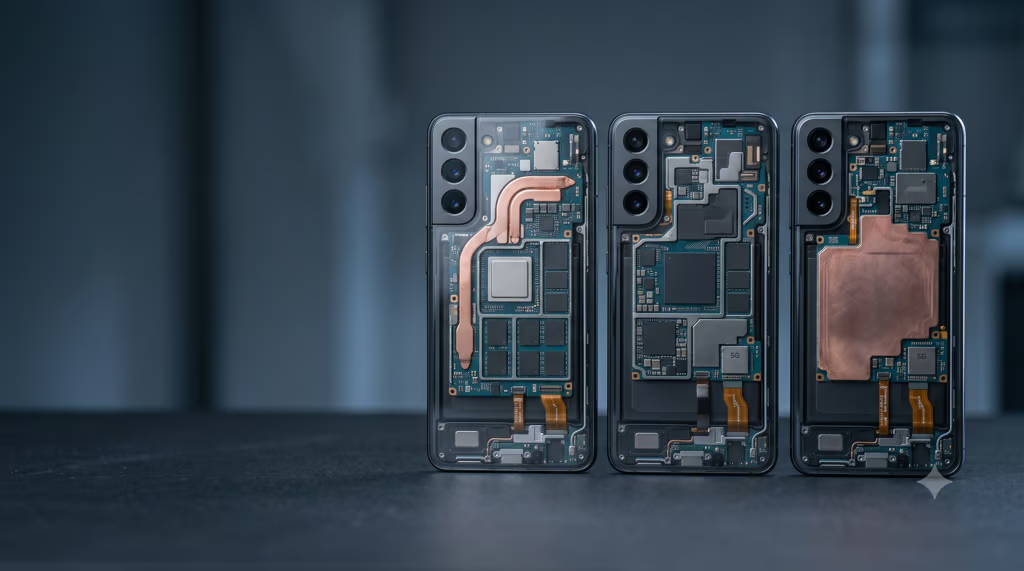


Two Android phones carrying the same family name may not contain the same hardware. As processor and component costs rise, manufacturers can protect established price tiers by using older chips, reducing specifications, or assigning different configurations to particular markets.
Those decisions can alter performance, network compatibility, camera processing, battery life, and on-device AI without producing an obvious change in branding. Global IT teams may need to approve exact regional configurations instead of treating every version of a phone family as interchangeable.
Familiar names may hide different hardware
Qualcomm CEO Cristiano Amon said during the company’s July 29 earnings discussion that higher input costs would lead to higher product prices. A customer letter obtained by Bloomberg separately described double-digit increases for products shipped after September 1, according to Reuters. Qualcomm declined to comment on the letter, which Reuters could not independently verify.
Phone manufacturers do not have to pass every added cost directly to customers. Qualcomm Chief Financial Officer Akash Palkhiwala said some manufacturers were already choosing previous-generation processors as component costs increased.
A new phone could retain an older chipset while receiving limited changes to its design, cameras, or software. Another manufacturer might keep the newest processor but reduce memory, storage, display quality, or less-prominent components.
Similar trade-offs are already affecting affordable Android phone designs, where higher memory costs have put pressure on processor, camera, and display choices.
Changing chip suppliers offers another route, but Snapdragon, MediaTek, and Samsung Exynos platforms are not interchangeable. Moving to another system-on-chip can require changes to circuit-board design, cooling, camera tuning, modem certification, firmware, and purchasing agreements.
Manufacturers may instead vary hardware by country. One market could receive a newer Snapdragon processor while another receives an older chip or competing platform under the same product-family name.
Regional variants complicate fleet approval
A chipset can affect supported network bands, modem behavior, graphics performance, image processing, power consumption, and the hardware available for local AI workloads. Those differences can affect deployment and support, not only benchmark results.
Software features can also vary by configuration. Some Android 17 and Gemini Intelligence capabilities are limited to selected devices or scheduled for later release. Availability may depend on the processor, memory, language, software version, and sales region.
Hardware variation expands testing requirements. IT teams may need to validate business applications, cellular service, mobile device management controls, accessories, and security behavior on multiple versions of the same phone family.
Operating-system support requires a separate review. The Android 17 rollout across manufacturers shows that Android updates already follow different vendor schedules. Multiple chipsets can introduce additional firmware, certification, and deployment paths.
Procurement records should specify the full model number, processor, memory and storage, network bands, supported AI features, warranty region, and update commitment. Evaluation units should match the configurations employees will receive.
A discounted previous-generation flagship may offer stronger value than a new model designed around cost reductions. Higher chip prices may increase some retail prices, but inconsistent regional hardware can create longer-lasting testing, support, and procurement costs for Android fleets.
Read more: Android 17’s expanded iPhone-to-Android migration tools can simplify onboarding, but organizations should still verify which transfer features each approved device supports.