


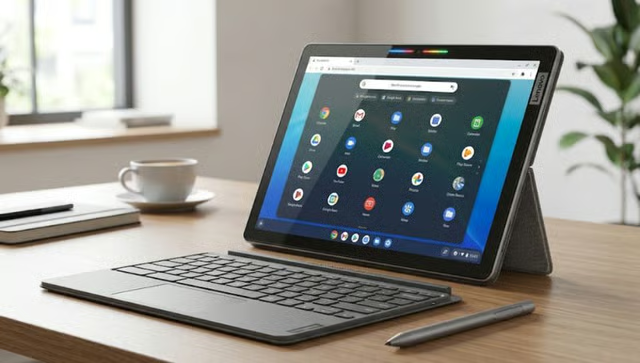
Google is preparing to take its new Googlebook platform beyond traditional laptops, with detachable tablets set to join the lineup soon.
The company confirmed the expansion during its Android Dev Summit 2026 developer keynote last week, outlining plans to support more hardware designs beyond the clamshell and convertible devices currently available. Google did not announce a launch date, pricing or a manufacturer for its upcoming detachable models.
The announcement gives fresh weight to earlier reports that Lenovo is developing a tablet-style Googlebook with a removable keyboard.
Lenovo could launch the first Googlebook detachable
Lenovo is emerging as the likely first manufacturer to bring the new form factor to market. Earlier leaks showed a tablet with a detachable keyboard, an integrated kickstand and Google’s Glowbar lighting feature positioned near the camera.
Recent regulatory filings have added to those indications. According to Android Authority, a Lenovo Bluetooth keyboard and stylus appeared in Federal Communications Commission (FCC) records under the identifiers O57DUET13BTKB and O57AP501U1.
The keyboard documentation reportedly includes Googlebook branding, while its schematics show pogo-pin connectors designed to attach it directly to the tablet. The device is expected to carry the Lenovo Googlebook Duet m name. Previous reports have pointed to a 13-inch display, 16GB of RAM and a MediaTek processor, although Lenovo has not confirmed these specifications.
Googlebook’s current lineup still favors laptops
The upcoming detachable would expand a lineup that currently consists of five devices, four of which use conventional clamshell designs.
As reported by 9to5Google, the existing models include the Asus Googlebook 14, Dell XPS Googlebook, HP Googlebook 14 and Lenovo Googlebook 15. Acer’s Googlebook 14 is the only convertible, offering laptop, tent and tablet configurations through its 360-degree hinge. It starts at $899.
A detachable would offer something different: users could physically separate the screen from the keyboard instead of folding the entire laptop backward. That distinction could make Googlebook more appealing to people who want a portable tablet without giving up a traditional keyboard for productivity tasks.
Google still has software work ahead
Hardware flexibility will not be enough to make the transition successful. Googlebook OS currently has limitations that could affect the experience on a device designed primarily for tablet use.
9to5Google reports that fullscreen applications can run in portrait orientation, but the operating system’s home screen, Overview interface and app tray remain restricted to landscape mode.
That creates an obvious problem for detachable devices, which users will naturally want to hold vertically when reading, browsing or using touch-focused applications. Google’s efforts to encourage developers to build applications that adapt to different screen sizes could help address some of these shortcomings. However, the operating system itself will also need a more complete tablet interface.
What detachable Googlebooks mean for users
Detachable Googlebooks could give consumers another option between conventional laptops and standalone tablets.
Students could use one device to take handwritten notes with a stylus, read, and type assignments. Business users could remove the keyboard during presentations or use the device as a tablet while traveling, then reconnect it when they need a more traditional computing setup.
However, pricing will be important. Google’s existing Googlebook lineup targets the premium laptop market, and the reported 16GB memory configuration suggests the first detachable may not compete with inexpensive Android tablets.
There is also a software question. Buyers will need to know whether Googlebook OS can deliver a comfortable tablet experience without sacrificing the Android applications and touch interactions they already expect.
More Google coverage
- New Google Search AI Mode is ‘Total Reimagining,’ Says CEO Sundar Pichai
- In Major Ruling, Judge Finds Google ‘Willfully Acquired and Maintained Monopoly Power’ Over Digital Ad Market
- Google’s Big Bet on Nuclear Energy: ‘The Race to Power AI-Driven Data Centers is Accelerating’
- Computer History Museum Releases Original AlexNet Code: Why It Matters
Google’s tablet strategy faces a new question
More importantly, detachable Googlebooks could complicate Google’s positioning of high-end Android tablets.
Googlebook OS offers a more desktop-oriented computing experience, potentially giving Google an alternative for users who want tablet portability alongside laptop-style productivity. However, that does not necessarily make conventional Android tablets redundant, particularly for consumers who prioritize entertainment, portability, and touch-first applications.
Google will need to establish a clear distinction between the two platforms rather than leave buyers uncertain about which device offers the better experience. For now, Lenovo’s rumored Googlebook Duet m looks like a promising candidate for the first detachable. But until Google and Lenovo confirm its specifications, pricing, and availability, consumers have little reason to make purchasing decisions around it.
Also read: For a closer look at how Google’s new platform compares with existing Chromebooks, read TechRepublic’s guide to ChromeOS vs. Googlebook OS, including differences in apps, compatibility, and upgrades.