


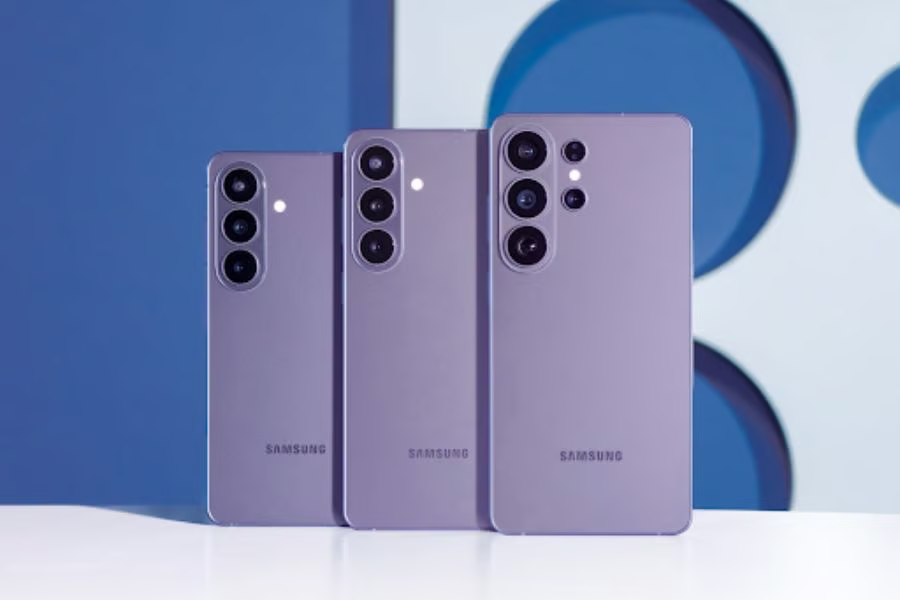
A scratched smartphone screen has a way of making an expensive flagship feel old overnight. Samsung may be exploring a surface designed to make some of those blemishes less noticeable on their own.
Industry observer Schrödinger claims Samsung and Corning are jointly working on a new self-healing surface coating for a future generation of Gorilla Armor, with the technology potentially headed to the Galaxy S27 Ultra, according to Android Authority. Neither Samsung nor Corning has confirmed or announced the technology for the Galaxy S27 Ultra.
The rumor is still notable because Samsung has used recent Ultra models to debut or showcase Gorilla Armor technology, including the original Gorilla Armor and Gorilla Armor 2.
What could self-healing Gorilla Armor actually do?
Don’t picture a shattered phone magically rebuilding itself.
The leak refers to a surface coating that could potentially recover from minor everyday micro-scratches. However, it remains unclear where Samsung might use the coating. Schrödinger’s post does not explicitly state that it would cover the S27 Ultra’s display, and Android Authority notes it could be used elsewhere on the phone.
The rumor also does not claim the technology could repair cracks, chips, deep gouges, or other structural damage.
That distinction could still matter for anyone carrying a phone for several years. Tiny scratches can accumulate from pockets, bags, grit, and everyday handling even when a screen never suffers a major drop.
Samsung and Corning have already targeted everyday scratch resistance with Gorilla Armor. The companies introduced the original Gorilla Armor on the Galaxy S24 Ultra in 2024. Samsung said Corning’s internal testing showed the material was more than four times as scratch-resistant as competing aluminosilicate cover glass while reducing reflections by up to 75%.
The Galaxy S25 Ultra followed with Gorilla Armor 2. Corning says the glass-ceramic material is designed to improve scratch and drop resistance.
That history makes another Gorilla Armor upgrade plausible, but it does not verify the latest rumor.
Why the Galaxy S27 Ultra connection isn’t far-fetched
Samsung has precedent for introducing new Gorilla Armor technology on its Ultra phones.
The Galaxy S24 Ultra debuted Gorilla Armor, while the S25 Ultra introduced Gorilla Armor 2. Corning also lists the Galaxy S26 Ultra among devices using Gorilla Armor 2.
That doesn’t establish a yearly release pattern, but it does make the Ultra lineup a plausible home for future Gorilla Armor technology if Samsung and Corning develop it for a commercial device.
Samsung is also continuing to push durability and longevity elsewhere in its Galaxy lineup. TechRepublic recently reported on Samsung’s August security update, which patched 56 vulnerabilities across supported Galaxy devices.
Software longevity has become another major selling point. Beginning with the Galaxy S24 series, Samsung committed to seven generations of operating system upgrades and seven years of security updates, a policy that creates a sharp divide between newer phones and older models, which are expected to miss Android 17.
As newer Galaxy phones receive longer software support, a surface that stays in better condition over time could become another useful durability feature.
Could you finally ditch the screen protector?
Probably not, at least not based on what has been reported so far.
The rumor only suggests that the coating could recover from minor scratches. It does not claim to prevent or repair cracking, chipping, deep gouges, or damage from drops. That means there is not yet enough information to conclude that a self-healing coating could replace the broader physical protection that some users rely on screen protectors to provide.
The bigger question is how effective the rumored coating would be in real-world use.
Samsung and Corning would need to explain which types of scratches can be repaired, how long the process takes, how the healing mechanism works, and whether the coating becomes less effective after years of use.
Those details are currently unknown. It isn’t even clear whether any version of the reported self-healing Gorilla Armor has been manufactured yet.
A tougher surface could matter as Samsung extends phone lifespans
Samsung’s upcoming hardware lineup shows why durability could become an increasingly useful competitive angle.
The company is preparing another addition to the Galaxy S26 family, with TechRepublic reporting that Samsung will unveil a new Galaxy S26 device at its Aug. 27 event. Leaks point to the Galaxy S26 FE, although Samsung has not formally named the device.
At the premium end of the market, keeping a flagship phone looking and working properly for years becomes increasingly valuable as manufacturers extend software support periods. A surface that can withstand some everyday wear could complement Samsung’s longer software-support promises by helping the physical hardware remain in better condition over the same period.
Mobility must-reads
- Big Apple OS Makeover: Here’s What to Expect & When
- MWC 2025: Nothing Shows Off (3A) Phones With AI Organization Tool
- Bad News for App Developers: Most Apps Fail to Hit $1,000 Monthly Revenue Within Two Years
- Mobile Device Computing Policy
What Galaxy buyers should watch next
For now, self-healing Gorilla Armor should be treated as an intriguing rumor rather than an expected Galaxy S27 Ultra feature.
The claim currently traces back to a single industry source, and Samsung and Corning have not announced the technology, explained how it works, confirmed where on a phone it might be used, or said which device might receive it. That could change as Samsung gets closer to its next Ultra launch.
If self-healing Gorilla Armor does arrive, the real test won’t be whether Samsung can put “self-healing” on a specifications sheet. It will be whether the technology can make everyday scratches less noticeable while maintaining the durability and clarity users expect from Gorilla Armor.
Until then, there’s no reason to throw away the screen protector just yet.
Also read: See how Samsung pushed its flagship lineup forward with new AI and privacy features in the Galaxy S26 series.