
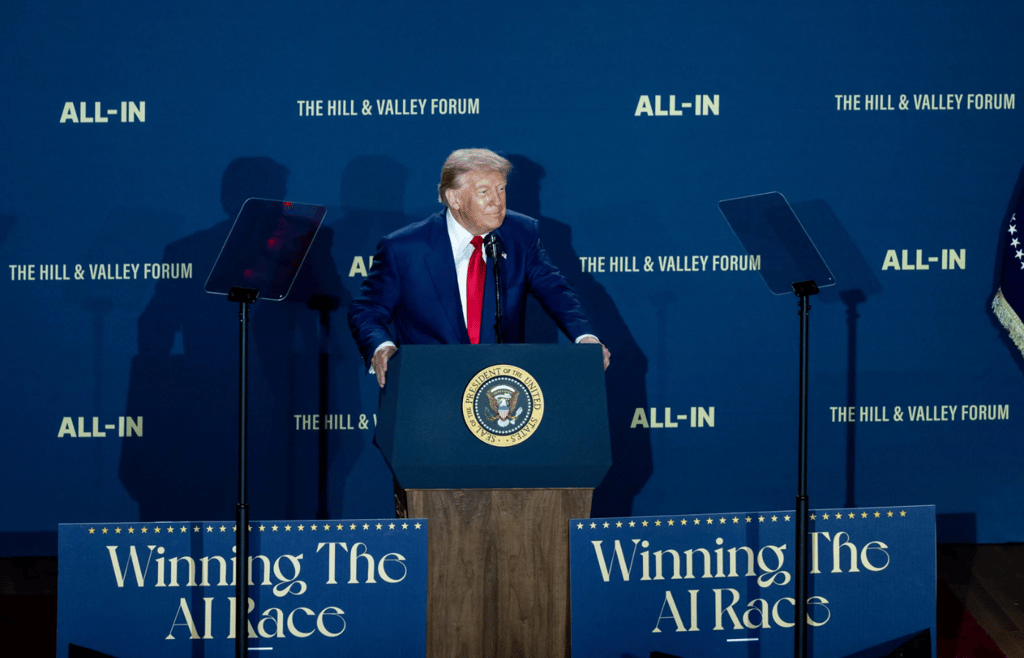


President Donald Trump has escalated trade tensions by threatening a 100% tariff on imported semiconductor chips, intensifying pressure on global tech companies to shift production to the US or face steep penalties.
The announcement marks a sweeping escalation in Trump’s push to bring chip manufacturing back to American soil. Companies that fail to commit to US investment will face what he called “a very large tariff,” shaking global tech supply chains and prompting urgent reassessments among industry leaders.
Semiconductor imports just became political leverage
According to Trump, chipmakers operating or planning to build domestically could avoid the proposed import tariff, while others would face steep new costs.
Though no formal policy has been issued, governments in key manufacturing hubs responded quickly. South Korean officials said their domestic firms would likely be exempt, citing ongoing investments in US sites. Taiwan’s economic ministry made similar statements regarding its leading chip producer.
For others, especially those without major US operations, the announcement raised new concerns about trade exposure and production strategy.
Exemptions promised, but who qualifies?
Trump has not defined what level of investment is required to avoid the tariff. It remains unclear whether existing facilities, such as those operated by TSMC or Samsung, are sufficient, or if new commitments are needed to qualify.
It’s also unknown how the administration plans to evaluate eligibility. No specific criteria have been released, and no agency has been tasked publicly with oversight or enforcement.
Questions also remain over which products the tariffs would apply to. It’s not clear if the policy targets only raw semiconductors or also end-user devices that contain chips.
Without written guidelines, companies are left to interpret Trump’s remarks and prepare accordingly.
Who’s building their way out of the tariff
Apple was the only company Trump publicly cited as an example of a firm that would avoid the proposed chip tariff. Yesterday Apple pledged an additional $100 billion toward US-based manufacturing, bringing its total domestic investment plan to $600 billion.
Other semiconductor giants have likewise increased their US footprints. TSMC expanded its investment to $165 billion in March, including multiple facilities in Arizona.
Samsung has existing Texas operations, part of a long-running expansion effort dating back to 2021. In June, GlobalFoundries announced a $16 billion to scale up domestic chip and packaging facilities.
In April, NVIDIA pledged up to $500 billion to build its AI infrastructure in the country, with chip production expected to run through partnerships tied to TSMC’s sites.
Despite these moves, none of the companies have been formally confirmed as exempt from the proposed tariff.
The pressure is working — and spreading
The industry isn’t waiting. Even without formal policy in place, companies are investing, governments are maneuvering, and the chip supply chain is already shifting, driven by the threat alone.
Trump wanted companies to move and create jobs at home. Now, they’re lining up to deliver.
Under mounting scrutiny, NVIDIA refuses to embed “kill switches” or backdoors in AI chips.