


YouTube is giving viewers something its homepage has rarely offered: a more direct say in what gets recommended.
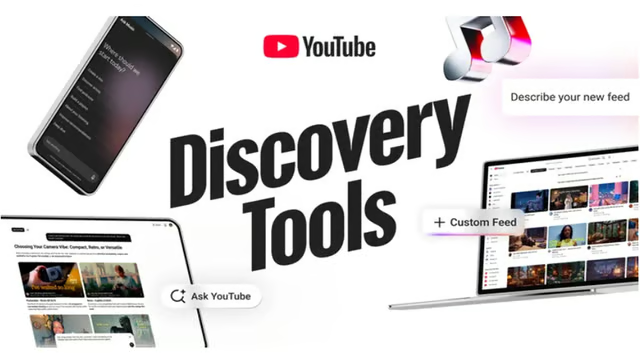
The Google-owned platform unveiled Custom Feeds at its Made on YouTube event last Wednesday, allowing users to create and save personalized homepage tabs using conversational AI prompts. Instead of relying entirely on viewing history, viewers can describe the type of content they want and have YouTube build a separate recommendation feed around it.
Users will be able to maintain multiple feeds for different interests or situations without replacing their normal Home experience, giving them more direct control without completely abandoning YouTube’s existing recommendation system.
Custom Feeds will soon roll out to users in the U.S. across the web, mobile devices and TVs. The feature uses large language models to interpret requests and build the resulting feed.
Custom Feeds keep experiments separate from Home
YouTube previously tested letting users directly steer their broader recommendation algorithm, but the company decided not to launch it after users expressed concerns about accidentally disrupting their recommendations.
“Users are always telling us that they want more control,” said YouTube Vice President of Product Management Emily Moxley, according to WIRED. “They want more ability to steer their algorithm. With custom feeds, we’re giving them a natural-language way that they can do that. They can tell us exactly what they want.”
Custom Feeds instead creates a separate space where viewers can experiment without replacing the standard Home experience. Users can switch back to the regular feed and maintain different feeds for different situations.
That makes the feature more than an AI search tool. It gives users a way to tell YouTube why they want certain content rather than repeatedly teaching the system through individual likes, dislikes, and viewing behavior.
What it means for YouTube viewers
The biggest change for viewers is flexibility. Someone interested in technology during the workday but documentaries at night could maintain separate feeds rather than allowing every temporary interest to influence the same recommendation stream.
There is still a limitation: Custom Feeds do not completely separate viewing behavior from YouTube’s wider recommendation system. Videos watched through a custom feed can enter standard watch history and may influence the main Home recommendations.
That means users gain more direct control over what they see, but the underlying recommendation system remains part of the experience.
More Google coverage
- New Google Search AI Mode is ‘Total Reimagining,’ Says CEO Sundar Pichai
- In Major Ruling, Judge Finds Google ‘Willfully Acquired and Maintained Monopoly Power’ Over Digital Ad Market
- Google’s Big Bet on Nuclear Energy: ‘The Race to Power AI-Driven Data Centers is Accelerating’
- Computer History Museum Releases Original AlexNet Code: Why It Matters
AI is also moving into YouTube shopping
Custom Feeds is part of a wider push to make YouTube more conversational. The company is expanding Ask YouTube with shopping-focused questions, follow-ups, and organized video recommendations.
For some product searches, YouTube may show comparison tables containing product attributes and categories based on a viewer’s preferences. Users can then continue asking questions about a product while watching a video.
Together, the features point toward a version of YouTube where users increasingly describe what they want rather than relying entirely on search terms or recommendation signals. For viewers, that could make discovery more flexible, although the usefulness of the experience will still depend on how accurately YouTube’s AI interprets those requests.
Other news: Beats has launched its $349.99 Beats 360 headphones with swappable ear and headband cushions, stronger active noise cancellation, up to 32 hours of battery life, and support for both Apple and Android devices.