


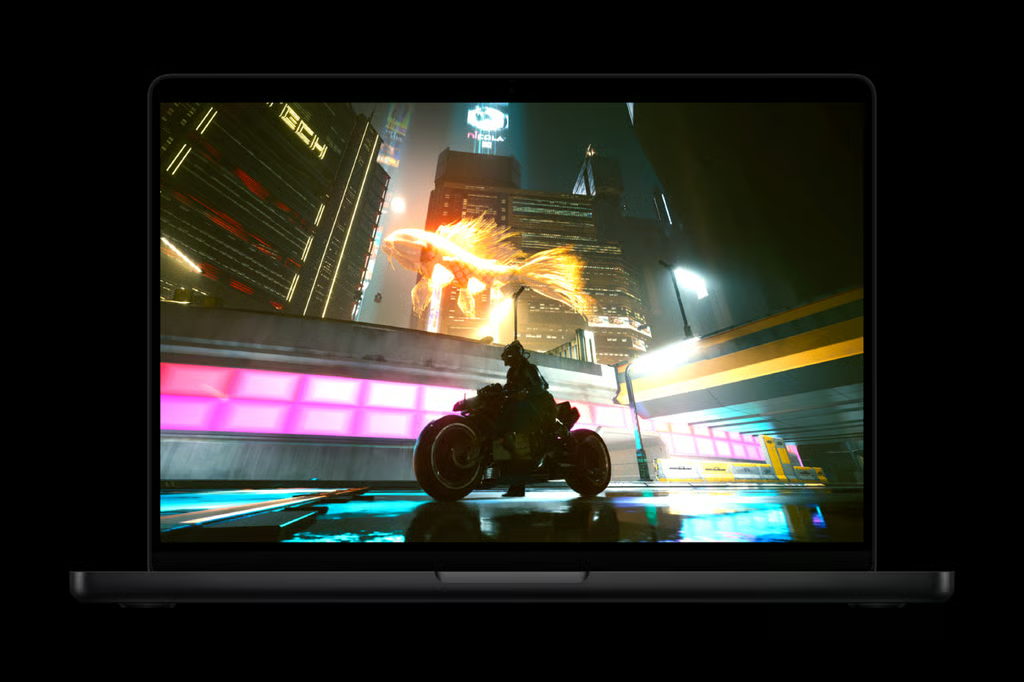
Apple just redrew the line for what on-device AI can do.
The company has unveiled its new M5 chip, a silicon overhaul that Johny Srouji, Apple’s senior vice president of Hardware Technologies, called “the next big leap in AI performance.” It’s designed to supercharge neural processing and energy efficiency across Apple’s latest devices.
In a press release, Apple stated that the M5 offers over four times the GPU compute power of its predecessor and more than six times that of the original M1, with Neural Accelerators integrated into every core. The chip is built on third-generation 3-nanometer technology, marking a major step toward faster, more efficient AI performance directly on Apple hardware.
Power, precision, and a breakthrough GPU core design
Apple introduced a redesigned 10-core GPU built for speed and balance, paired with an updated media engine for heavier creative workloads.
Graphics see up to 45% uplift over M4, while the CPU posts 15% faster multithreaded performance, anchored by what Apple calls “the world’s fastest performance core.”
Apple also points to third-generation ray tracing and rearchitected dynamic caching for smoother gameplay and more responsive 3D apps.
AI at full throttle, no cloud required
Apple’s latest silicon is built to run AI on the device. No data offloading. No lag.
Its 16-core Neural Engine works in sync with the new GPU accelerators, powering everything from diffusion models in creative apps to large language models processed locally through platforms like webAI.
According to Apple, this unified design translates into quicker execution for Apple Intelligence features, including tools like Image Playground and Genmoji, which now generate results with less latency and lower power draw.
For developers, M5 unlocks new performance gains automatically through Apple’s frameworks. Apps using Core ML, Metal Performance Shaders, Metal 4, or the Foundation Models framework can instantly tap into the chip’s Neural Accelerators or even program them directly using Tensor APIs, tightening the loop between AI design and real-world speed.
Must-read Apple coverage
- iOS 27 AI Shortcuts: What Changed and 5 Useful Things to Try
- iPhone Duo Camera Tricks: Smart Take, Kid Cue, Duo Preview, and More
- macOS 27 Cheat Sheet: Compatible Macs, Siri AI, Features and What Changed
- Common Mistakes When Using One Apple Account on Multiple iPhones
- 9 Hidden macOS Features That Feel Like Productivity Hacks
Speed meets sustainability
The M5 features 153 GB/s of unified memory bandwidth — nearly 30% higher than M4 — and up to 32 GB of memory. That extra headroom lets users run larger AI models and juggle demanding creative workloads like Photoshop and Final Cut Pro without slowdowns.
That same architecture keeps efficiency at the forefront. By drawing less power per operation, the chip supports Apple’s 2030 carbon-neutral goal on the devices it powers.
Sharper and more responsive visuals
On Apple Vision Pro, M5 renders about 10% more pixels and supports up to 120Hz, delivering crisper detail and reduced blur in spatial apps and 3D experiences on the headset’s micro-OLED displays.
The upgrade could also help revive momentum for Vision Pro. Adoption has lagged amid a limited library of immersive content, but sharper visuals and fluid performance may give developers new incentive to expand the lineup, and users a fresh reason to reengage with the device.
The M5 rollout begins
Apple’s new chip arrives first in the 14-inch MacBook Pro, iPad Pro, and Apple Vision Pro, with preorders now open. Each device runs the same silicon foundation: a clean start to Apple’s next hardware cycle built around native AI speed.
Apple’s silicon upgrade meets a subtler shift in streaming as Apple TV drops the plus for consistency.