


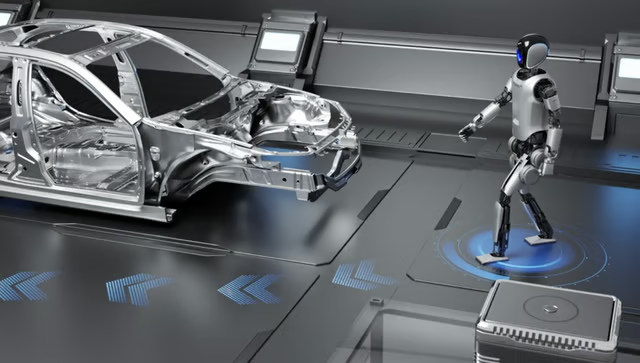
UBTECH’s humanoid robots could soon take on a new role in Volkswagen’s Chinese factories: helping move parts and materials through production facilities.
The company and FAW-Volkswagen signed a strategic cooperation agreement on Oct. 8 to develop and test humanoid robots for factory logistics and smart manufacturing, according to reports from Interesting Engineering and Gasgoo.
The companies plan to build demonstration scenarios and evaluate the robots in manufacturing environments. However, they have not announced a robot order, named the logistics tasks to be tested or provided a timetable for routine deployment.
The agreement builds on work at FAW-Volkswagen’s Qingdao factory that began in 2024. UBTECH tested its Walker S platform on production-line activities, including bolt tightening, component installation, and parts handling. Later, its Walker S Lite participated in vehicle quality-inspection training and connected to the plant’s automation control system.
The latest agreement expands that relationship into logistics, where robots could eventually help move components and materials between work areas.
UBTECH is preparing for larger deployments
UBTECH’s industrial robotics platform combines AI models for understanding environments and selecting actions with motion-control systems, physical hardware and technology for coordinating multiple robots.
The company is also expanding its manufacturing capacity. Its 14,000-square-meter humanoid robot factory in Liuzhou, Guangxi, began operating last month. The facility is designed to produce more than 10,000 robots annually. That production capacity could support larger industrial trials as demand grows. However, it does not establish that FAW-Volkswagen has ordered robots or that the factory is already supplying its facilities.
The real test is keeping production moving
Factory logistics presents a different challenge from inspecting a vehicle or completing a controlled assembly task. Robots must navigate changing environments, handle materials consistently and work safely around employees and existing machinery.
Humanoid robots could offer manufacturers more flexibility by handling different tasks without major changes to existing workspaces. But that flexibility matters only if the robots can perform reliably at the pace required by production lines.
For automakers, the important measure will be whether these systems reduce delays, improve material delivery and justify their operating costs. Training, maintenance, safety measures and integration with existing automation will also affect whether the technology makes financial sense.
FAW-Volkswagen’s five production bases in China, spanning Changchun, Chengdu, Foshan, Qingdao and Tianjin, offer potential environments for future testing, Interesting Engineering reported. The companies have not identified which facility will host the new logistics demonstrations.
What's hot at TechRepublic
- Blackpoint Cyber vs. Arctic Wolf: Which MDR Solution is Right for You?
- Why AWS Sellers Choose Deepgram Over Other Voice AI Tools
- SS&C Intralinks DealCentre AI vs. Datasite: Which platform is built for the future of dealmaking?
- SS&C Intralinks FundCentre AI vs. Juniper Square: Which platform better supports modern private markets fund managers?
- Verito vs. Rightworks: Which IT Provider Is Best for Your Firm?
What this means for factory workers and car buyers
For factory workers, successful deployments could shift some repetitive material-moving duties to robots, allowing employees to focus on tasks that require judgment, troubleshooting and oversight.
However, the agreement does not establish whether the technology will change staffing levels or how responsibilities might shift. Its ability to handle factory logistics reliably remains unproven under the proposed trials.
Car buyers could benefit indirectly if more adaptable factory logistics helps automakers manage different vehicle configurations and keep production running smoothly. Any effect on delivery times, vehicle prices or customization options remains uncertain.
For now, the partnership is a testing program, not a confirmed rollout. Evidence of repeatable performance, named logistics tasks and regular operations will determine whether UBTECH’s humanoids become working members of Volkswagen’s factory ecosystem or remain limited to demonstrations.
Other news: Toshiba is expanding hard disk drive production in the Philippines to meet growing demand for AI and cloud data storage.