


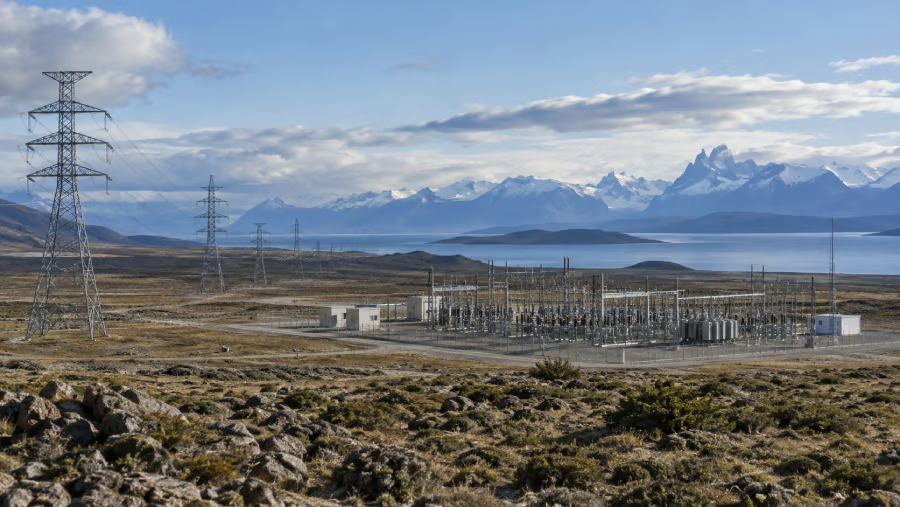
Patagonia’s next big export may be computing power. Argentina’s wind-swept southern region is attracting proposals for AI data centers worth billions of dollars, drawn by cool weather, abundant energy, and large stretches of available land.
Projects under discussion include a $1.4 billion FlexDomes facility in Neuquén and a $3 billion Green Capital development in Chubut. OpenAI has also signed a letter of intent concerning a separate proposal that could involve up to $25 billion. For technology buyers and infrastructure planners, the opportunity comes with a catch: the region still needs major upgrades to its power grid and network connectivity before these plans can become operating data centers.
Patagonia has energy, but infrastructure is the test
Reuters reported that Pampa Energia is seeking investors for a data center next to its Loma de la Lata thermal power plant in Neuquén. The project could consume up to 500 MW, while the electrical infrastructure needed to support that scale would cost nearly $900 million, according to company commercial director Ruben Turienzo.
Neuquén’s cold climate could reduce cooling costs, while hydroelectric power and nearby Vaca Muerta gas give operators multiple energy options. Connectivity and electrical infrastructure remain major hurdles, however. Data center adviser Hadassa Lutz told Reuters that having an available energy source does not necessarily mean a location has the infrastructure needed to support a data center.
Firstpost also noted that Argentina’s existing data center footprint remains small and concentrated largely around Buenos Aires. Expanding into Patagonia would therefore require the country to build supporting digital infrastructure alongside the server farms themselves.
More about data centers
- Stargate Norway: OpenAI’s First AI Data Center in Europe
- AI Data Centers’ Soaring Energy Use: Who Pays for Higher Utilities Costs?
- China’s Submerged AI Data Center Could ‘Influence Global Sustainable Computing’
- Google to Power Data Centers With Nuclear Energy by 2030 in First-Of-A-Kind’ Agreement
OpenAI adds a $25 billion proposal to the pipeline
OpenAI is attached to the largest proposal so far.
The Buenos Aires Herald reported in October 2025 that OpenAI signed a letter of intent to work with Sur Energy on Stargate Argentina. The proposed data center could reach 500 MW, use renewable energy, and involve up to $25 billion in investment, although its financing and final agreement have not been secured. The project was expected to use Argentina’s RIGI investment program, which offers tax and currency incentives for large foreign-currency investments.
The commitment is not final. Reuters reported that Sur Energy co-founder Emiliano Kargieman said in August that a definitive contract with OpenAI had not yet been signed. Pampa Energia, meanwhile, said interested parties want to start with smaller 20 MW to 40 MW pilots before considering expansion toward 500 MW.
Billion-dollar plans still need investors and infrastructure
Other proposals underline both the scale of interest and the uncertainty. FlexDomes is seeking investors for a first phase in Neuquén with 120 MW of IT load and an estimated cost of $1.4 billion. Poland’s Green Capital has outlined a $3 billion first phase in Chubut that could reach 300 MW, but it still needs investors and plans to apply for an investment regime in 2027, Reuters reported.
For enterprises tracking where new AI capacity may emerge, Patagonia offers potentially favorable energy and climate conditions — but it is not yet a dependable data center market.
Signed contracts, secured financing, pilot deployments, transmission upgrades, and new fiber connections will be more meaningful indicators than the projects’ headline valuations. Until those milestones arrive, technology buyers should treat Patagonia as a prospective source of AI capacity rather than a confirmed one.
Read more: For another example of how hyperscale AI projects can test local energy infrastructure, see whether Australia’s grid could handle Anthropic’s reported plans for 5GW of AI data centers.