


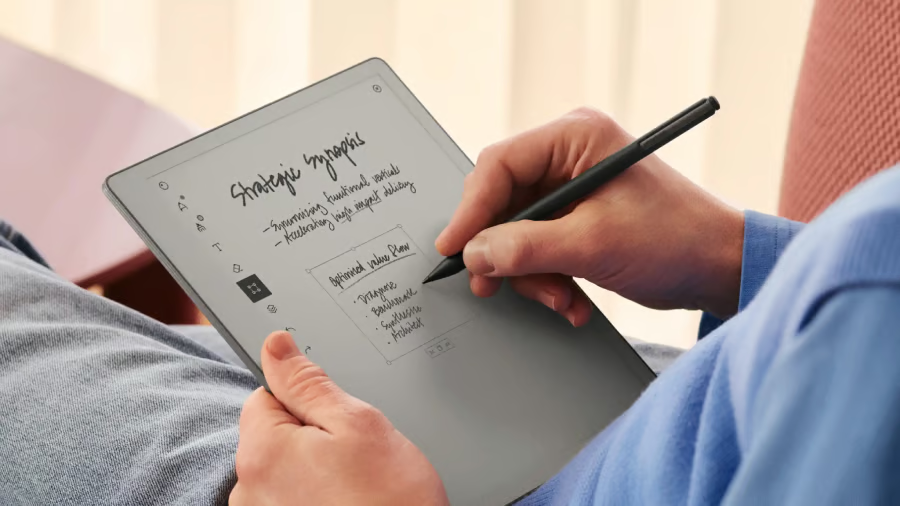
reMarkable made a tablet that seems almost allergic to being a tablet.
The company’s Paper Pure looks like a conventional tablet at first glance, with a processor, Wi-Fi, storage, and a large touchscreen, but its software is intentionally restrictive. It has no app ecosystem, notifications, or multitasking tools designed to keep users bouncing between tasks. Instead, it is built primarily for writing, sketching, and reading.
That restraint is the point. Starting at $399 with a Marker included, the Paper Pure succeeds the reMarkable 2 with what reMarkable describes as 50% faster performance, 20% higher display contrast, four times the storage, and up to three weeks of battery life. Handwriting conversion, calendar-linked meeting notes, and document syncing support a digital workflow without turning the device into an iPad alternative, although some of these features require a Connect subscription.
It is a different answer to the question of what a tablet should be: not a computer that happens to have a touchscreen, but a digital notebook that happens to have a computer inside.
What’s inside the reMarkable Paper Pure
The Paper Pure is built around a 10.3-inch monochrome E Ink display with a resolution of 1,872 times 1,404 and 226 pixels per inch. reMarkable calls it a Canvas display, and the tablet includes palm rejection.
Palm rejection lets users rest a hand on the screen while writing without creating unintended marks, making the experience closer to using a paper notebook.
Under the display is a 1.7GHz dual-core Cortex-A55 processor paired with 2GB of LPDDR4 RAM. Those specifications are modest compared with an iPad or Android tablet, but the Paper Pure does not need to run conventional tablet apps or support intensive multitasking. The device is powered by a custom Linux OS known as the reMarkableOS.
Storage has also received a major upgrade. The Paper Pure comes with 32GB of internal storage, which, according to The Independent, is four times the 8GB offered by the reMarkable 2.
reMarkable rates the 3,820mAh battery for up to three weeks of use, based on one hour of daily note-taking.
Some workflow features require reMarkable’s Connect subscription, including handwriting search, unlimited cloud storage and syncing, AI-powered conversion, and note editing through the desktop and mobile apps. Without Connect, only files used and synced within the previous 50 days remain stored in the cloud.
The Paper Pure also lacks a built-in reading light, so users will need an external light in dark environments. Its monochrome display may also be limiting for people who read color documents, charts, or illustrated content.
What's hot at TechRepublic
- Blackpoint Cyber vs. Arctic Wolf: Which MDR Solution is Right for You?
- Why AWS Sellers Choose Deepgram Over Other Voice AI Tools
- SS&C Intralinks DealCentre AI vs. Datasite: Which platform is built for the future of dealmaking?
- SS&C Intralinks FundCentre AI vs. Juniper Square: Which platform better supports modern private markets fund managers?
- Verito vs. Rightworks: Which IT Provider Is Best for Your Firm?
When doing less becomes the feature
The Paper Pure makes more sense as part of a broader push toward devices that deliberately limit what they can do.
A New York Magazine report points to a resurgence of single-purpose gadgets, arguing that some consumers want technology that does one job well without pulling them into everything else their smartphone can do.
That shift is showing up in phones, too. The Minimal Phone 2 cuts back on the features that encourage endless scrolling, while the Enough Phone takes a different route by emphasizing compact dimensions, repairability, and a removable battery instead of maximizing screen size and multitasking features.
That puts the Paper Pure within a broader product movement rather than treating it as an isolated experiment. The technology varies, but the underlying idea is similar.
What this means for users
The appeal of devices like the Paper Pure ultimately depends on what you want technology to do for you.
If you spend your day jumping between notifications, messages, social feeds, and work apps, a device that deliberately shuts most of that out could make focused writing or reading easier. But if you rely on a tablet to handle many jobs at once, those same restrictions could quickly become frustrating.
That makes the Paper Pure less about finding a better tablet and more about choosing the right kind of digital tool. You are trading flexibility for focus, and the growing interest in products built around that trade-off suggests that some users may be willing to give up features if it means getting more control over their attention.
For anyone considering the Paper Pure, the question is fairly simple: do you need another device that can do almost everything, or would you benefit from one designed to do a few things exceptionally well?
Read more: If distraction-free hardware feels too restrictive, compare the best digital planners for organizing notes, schedules, and everyday work without giving up a full app ecosystem.