
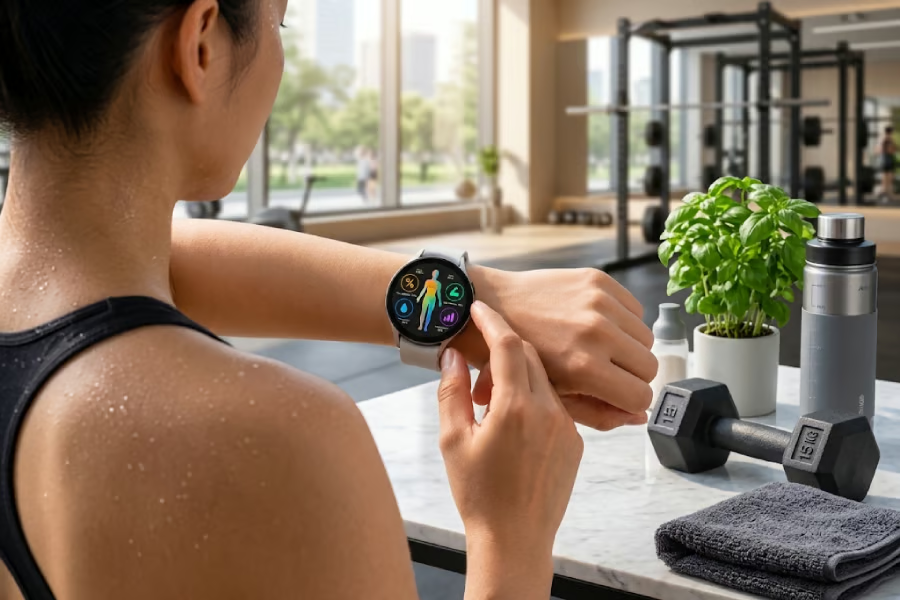


Your Samsung Galaxy Watch can estimate how much of your body is fat, muscle, and water in seconds. But not every number on the screen deserves the same amount of trust.
A 2025 peer-reviewed study comparing the Galaxy Watch5 with dual-energy X-ray absorptiometry (DXA) found strong group-level agreement in body fat percentage, but individual readings could still vary considerably. Its estimates of skeletal-muscle percentage showed substantially weaker agreement with DXA.
That distinction matters as Samsung puts more health information on users’ wrists. Body-composition measurements may provide useful general information, but research suggests Galaxy Watch owners shouldn’t treat them as equivalent to a clinical body-composition test.
How the Galaxy Watch measures your body composition
Galaxy Watch models with Samsung’s Bioelectrical Impedance Analysis, or BIA, sensor estimate body composition by sending tiny electrical currents through the body.
According to Samsung’s explanation of the body-composition feature, the watch uses BIA to estimate body composition metrics such as skeletal muscle, fat mass, body fat percentage, body water, BMI, and basal metabolic rate.
The technology itself isn’t unusual. BIA is also used in smart scales and dedicated body-composition analyzers. The unusual part is squeezing it onto your wrist. Instead of standing barefoot on a scale or using a clinical machine, Galaxy Watch users place two fingers on the watch’s buttons while keeping their arms away from their torso. The watch then calculates the user’s body-composition estimates.
Samsung introduced wrist-based body composition with the Galaxy Watch4 generation, and body composition remains part of the company’s broader wearable-health strategy.
TechRepublic has also covered Samsung’s expanding wearable-health strategy, which increasingly combines sleep, activity, cardiovascular signals, and body-composition data into broader wellness insights.
But convenience doesn’t necessarily mean clinical accuracy.
Galaxy Watch was much better at estimating body fat than muscle
Researchers put the watch to the test in a 2025 study published in Frontiers in Sports and Active Living.
The study included 108 physically active adults and compared measurements from a Samsung Galaxy Watch5 and an InBody 770 clinical BIA analyzer with DXA. That population is worth keeping in mind. The results shouldn’t automatically be assumed to apply equally to every Galaxy Watch owner.
For body-fat percentage, the Galaxy Watch showed strong overall agreement with DXA.
Researchers reported a concordance correlation coefficient, or CCC, of 0.91 between the Galaxy Watch and DXA for body-fat percentage. The watch’s mean absolute error was 2.87 percentage points, while the average difference was about -0.88 percentage points.
But those averages don’t tell the whole story.
The limits of agreement ranged from approximately -7.85 to 6.1 percentage points, indicating that individual Galaxy Watch readings could differ considerably from DXA measurements. The researchers also reported a mean absolute percentage error of about 14.36%, and the Galaxy Watch did not meet the study’s overall equivalence criteria for body-fat percentage.
The study also identified proportional bias, with errors increasing as body fat percentage increased.
So a CCC of 0.91 doesn’t mean a Galaxy Watch body-fat reading is 91% accurate. It means the two methods showed strong concordance across the study population, while individual measurements could still differ meaningfully.
The muscle results deserve even more caution. For skeletal muscle percentage, the Galaxy Watch yielded a CCC of only 0.45 compared with DXA. Its mean absolute error was 6.47 percentage points, and it underestimated skeletal-muscle percentage by an average of about 6.46 percentage points.
Interestingly, the dedicated InBody 770 BIA machine also struggled with skeletal muscle percentage in this study, showing even weaker concordance with DXA.
Why your Galaxy Watch reading can change
Even a wearable that produces useful body-composition estimates can return different results depending on how and when a measurement is taken.
Samsung recommends taking measurements under consistent conditions and at a similar time of day. The company also advises users to measure before activities that raise body temperature, such as exercise or sauna use, and to avoid metal accessories that could interfere with the measurement.
Posture matters, too.
Samsung instructs users to raise their arms away from their torso, remain still, and place their middle and index fingers on the watch buttons without pressing them. Those instructions matter because BIA isn’t directly measuring inside your body to count fat or muscle. It estimates body composition based on electrical impedance, meaning measurement conditions can influence the result.
Using the same measurement conditions can help reduce some of those variables, though that doesn’t mean the watch has been proven to reliably detect body composition changes over time.
What's hot at TechRepublic
- Blackpoint Cyber vs. Arctic Wolf: Which MDR Solution is Right for You?
- Why AWS Sellers Choose Deepgram Over Other Voice AI Tools
- SS&C Intralinks DealCentre AI vs. Datasite: Which platform is built for the future of dealmaking?
- SS&C Intralinks FundCentre AI vs. Juniper Square: Which platform better supports modern private markets fund managers?
- Verito vs. Rightworks: Which IT Provider Is Best for Your Firm?
So, should you trust your Galaxy Watch’s body fat reading?
The Galaxy Watch may provide useful general information about body composition, particularly body-fat percentage. But the 2025 study found enough individual variation that a single reading shouldn’t be treated as equivalent to a DXA measurement.
There’s another important limitation: the study wasn’t designed to determine how reliably the Galaxy Watch5 can detect changes in the same person over weeks or months.
Participants underwent the body-composition assessments during a single visit. The researchers specifically said future studies should investigate whether these devices can accurately detect longitudinal changes in body composition.
That means users should be careful not to assume that a series of changing Galaxy Watch readings necessarily reflects the same degree of change in their actual body composition.
Muscle estimates warrant even greater caution based on the 2025 results. That distinction fits a broader rule for wearable health technology: useful health information doesn’t automatically equal a medical measurement.
TechRepublic found a similar boundary when examining Samsung Galaxy Watch diabetes management. Galaxy Watch can integrate glucose data from compatible sources with medication, activity, sleep, and other health data, but it doesn’t replace an authorized glucose-monitoring device or medical care.
Samsung draws a similar line around body composition. The company says its body-composition measurement is intended for general personal information and isn’t designed to detect, diagnose, or treat a medical condition or disease.
Samsung also says people who are pregnant or have an implanted pacemaker or other implanted medical device shouldn’t use the body-composition measurement. The company warns that results may not be accurate for people under 20.
The best way to use Galaxy Watch body composition
The most useful approach may be to stop treating the Galaxy Watch like a miniature medical scanner.
Instead, think of its body-composition feature as another source of wellness information, with important limitations.
Take measurements under similar conditions to reduce variables that could affect BIA readings. Avoid putting too much weight on small changes or individual decimal points. And be especially cautious about interpreting estimated skeletal muscle, given the weaker agreement seen in the 2025 study.
Whether the Galaxy Watch can reliably identify real body composition changes in the same person over time remains an open research question. That approach also fits the broader direction Samsung is taking with wearable health.
Samsung is pushing Galaxy Watch data into increasingly sophisticated health and research applications, while maintaining a boundary between wellness information and medical diagnosis. TechRepublic recently covered how Samsung is expanding Galaxy Watch data into clinical research, where researchers are exploring whether wearable biometric data could eventually support validated research endpoints and biomarkers.
That’s an important distinction for Galaxy Watch owners.
Galaxy Watch makes body-composition data easy to access, but that convenience comes with limits. Research suggests its body-fat estimates can align well with DXA across a group, while individual readings can vary and skeletal-muscle estimates are less reliable. Researchers also haven’t established how accurately the watch tracks body-composition changes over time.
For users, the takeaway is simple: use the numbers as a guide, not a medical verdict.
Also read: For more ways to get useful health data from your smartwatch, see which Galaxy Watch9 settings you should enable in your first 24 hours.