


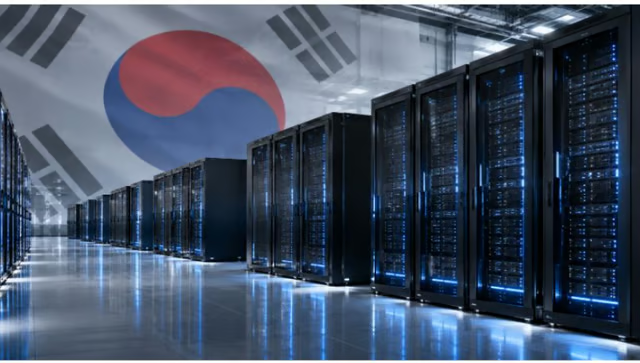
South Korea is preparing to switch on a supercomputer capable of performing up to 614 quadrillion calculations per second, with researchers and companies among those lining up for access.
Hangang, the country’s sixth national supercomputer, is scheduled to enter official service in December and will feature 8,496 GPUs, 9,936 CPUs, 205 PB of storage, and network speeds above 400 Gbps.
The government plans to allocate its computing resources among national projects, researchers, universities, and companies, giving Korean organizations another route to high-end computing without securing their own GPUs or relying on private cloud services.
Most of Hangang’s capacity is already earmarked for research and national projects.
Hangang packs 8,496 GPUs and 205 PB of storage
Seoul Economic Daily reported that Hangang uses Nvidia GH200 accelerators, which combine Grace CPUs with H100 GPUs to improve data-processing efficiency. Its theoretical performance of 614 petaflops means up to 614 quadrillion floating-point operations per second.
Compared with South Korea’s fifth national supercomputer, Hangang offers 24 times the theoretical computing performance, 10 times the storage, and four times the network performance. The Ministry of Science and ICT expects the system to rank around the global top 10 once it is operating.
What 614 petaflops can actually be used for
Hangang is intended for large-scale computational science, data simulation, and AI-based scientific research. The government will allocate 55% of the system to R&D innovation and another 30% to national strategy projects, including work tied to strategic technologies.
According to ChosunBiz, large-scale research projects requiring ultra-large simulations or highly parallel computing can receive resources equivalent to 50 nodes. General computational science and AI projects can receive two to 49 nodes, while a new exploratory track will provide one node after a lighter review. Each node contains four GH200 accelerators.
Smaller projects can start with one four-GH200 node, while the largest research projects can receive resources equivalent to 50 nodes.
What Hangang changes for Korea and APAC
Hangang is designed to widen access to high-end computing in Korea, while its shared-use model could also be relevant elsewhere in APAC.
Korean researchers and companies get another route to high-end compute
For Korean researchers and businesses, Hangang offers access to high-performance computing without requiring them to build comparable infrastructure themselves. ChosunBiz reported that organizations have previously had to secure high-end GPUs or use private cloud services, adding cost and data-security concerns.
The 15% allocation for industrial users is aimed partly at small and venture companies that may struggle to build their own HPC environments. KISTI will also provide consulting and technical support alongside the computing resources.
Applications for the pilot service run from Sept. 23 to Oct. 8, with selected users expected to get access from late October to mid-November. Official-service applications run from Sept. 28 through Oct. 16, with allocations beginning in December.
More must-read AI coverage
- SS&C Intralinks DealCentre AI vs. Datasite: Which platform is built for the future of dealmaking?
- SS&C Intralinks FundCentre AI vs. Juniper Square: Which platform better supports modern private markets fund managers?
- Why Data, Not Models, Determines AI Success
- The Rise of the AI-Native Factory: How Physical AI Is Transforming Manufacturing
Korea’s approach offers an APAC case study
Korea is pooling expensive GPU resources in national infrastructure and sharing them across government, academia, and industry. The approach could offer a useful model for other APAC markets looking to expand access to AI and scientific computing without requiring every organization to procure its own hardware.
Building that shared capacity cost much more than South Korea initially planned. Interesting Engineering noted that Hangang ultimately cost 448.3 billion won, about $334.9 million, 53% above its original budget as GPU demand pushed prices higher/
Hangang also relies on Nvidia accelerators and an HPE-built platform. Korea may be increasing domestic computing capacity, but it remains exposed to the hardware costs and supply pressures affecting other buyers in the region.
Pilot access starts in late October, with full service set for December. How much researchers and smaller companies use that capacity could help show whether Korea’s shared-compute model makes sense elsewhere in APAC.
Also read: South Korea’s supercomputing push comes alongside broader investment in domestic hardware, including a proposed $1.9 billion for semiconductors in its record 2027 budget.