


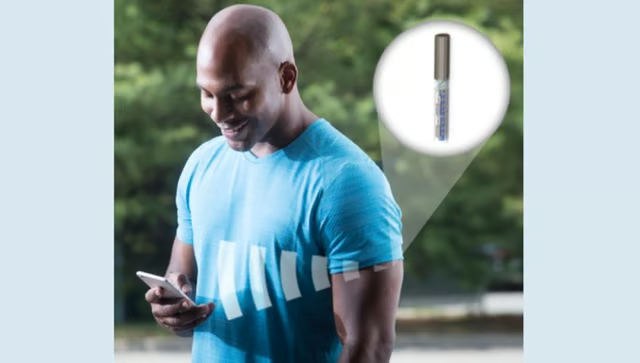
Continuous glucose monitoring often means keeping a device attached to the skin. A new implantable monitor under development could eliminate that part of the routine.
Senseonics announced on Oct. 26 that it has begun the first human study of Freedom, a glucose monitor being developed to track blood sugar for up to a year without anything worn on the body.
Clinical testing will now determine whether the proposed design works safely and reliably.
How Freedom eliminates the external transmitter
Senseonics’ existing Eversense 365 system uses a small sensor implanted beneath the skin of the upper arm for up to 365 days. However, users still wear a rechargeable transmitter secured over the sensor with an adhesive patch changed daily. Glucose readings are sent to a smartphone app and can also appear through compatible Apple Watch apps.
Freedom incorporates a battery and Bluetooth communication technology directly into the implanted sensor. Readings would travel to a smartphone without an external transmitter, eliminating its charging routine and daily adhesive changes.
Unlike experimental non-invasive glucose-monitoring technologies, Freedom would still involve a medical procedure to insert the sensor beneath the skin and eventually replace it.
Early wireless tests lead to human trials
Before the human study, Senseonics evaluated multiple Bluetooth antenna designs and implant locations during preclinical testing completed in the second quarter of 2026. Engineers examined which combination could maintain dependable communication between the implanted sensor and a nearby mobile device.
During approximately seven weeks of preclinical testing, Senseonics reported a 100% communication success rate within its target distance, based on more than 18,500 data points.
The results suggest that the implanted sensor can maintain wireless communication under the tested conditions. However, they do not establish how reliably Freedom will perform in everyday use or whether it can deliver accurate glucose readings over its proposed one-year lifespan.
Researchers are now evaluating Freedom’s safety and functionality in an early human feasibility study. Findings will inform a larger pivotal trial planned for 2027, with Senseonics targeting a potential commercial launch in 2028.
Freedom remains investigational, and its availability will depend on successful clinical testing and regulatory review.
What's hot at TechRepublic
- Blackpoint Cyber vs. Arctic Wolf: Which MDR Solution is Right for You?
- Why AWS Sellers Choose Deepgram Over Other Voice AI Tools
- SS&C Intralinks DealCentre AI vs. Datasite: Which platform is built for the future of dealmaking?
- SS&C Intralinks FundCentre AI vs. Juniper Square: Which platform better supports modern private markets fund managers?
- Verito vs. Rightworks: Which IT Provider Is Best for Your Firm?
Patients will need answers about glucose alerts and reliability
People who experience adhesive irritation or frequently struggle to keep a transmitter attached during exercise could benefit from Freedom’s proposed design. Patients who depend on timely low-glucose warnings, however, also need to consider how they would receive alerts during sleep or periods away from their phones.
Current Eversense 365 smart transmitters can vibrate to warn users about glucose levels even when their smartphones are out of range. They also store collected readings until the connection returns.
Senseonics has not detailed whether Freedom will provide independent alerts or store readings when a connected phone is unavailable. Those capabilities will be important considerations for patients who depend on continuous glucose monitoring.
Before choosing a future transmitter-free monitor, patients should confirm whether urgent warnings remain active during phone disconnections and how notification settings affect their delivery.
People who depend on overnight alarms should review these safeguards with their healthcare team and compare them with the protections available through existing CGM and smartwatch combinations.
Freedom could reduce the inconvenience of wearing a glucose monitor, but dependable warnings and uninterrupted access to readings will ultimately determine how well it supports everyday diabetes management.
Related reading: New research suggests that continuous glucose monitors could be useful for more diabetes patients than those who depend on insulin.