


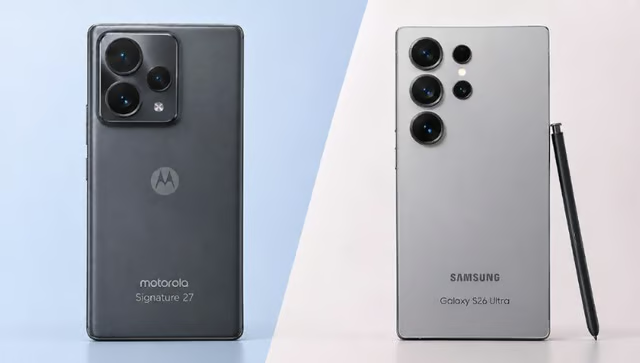
Motorola has a $1,600 question for Samsung: What if a flagship phone offered a bigger battery, faster charging, and a 200MP zoom camera, but didn’t have the Galaxy name?
The newly unveiled Motorola Signature 27 starts at $1,599, putting it directly against Samsung’s Galaxy S26 Ultra. The phones are similarly priced when comparing Motorola’s starting MSRP with Samsung’s regular price for its 512GB model, although Samsung currently offers discounts.
Motorola is betting on its newer Snapdragon processor, 7,000mAh battery, and high-resolution telephoto camera. Samsung counters with its built-in S Pen, Privacy Display, and established productivity features.
Both promise years of software support, but they offer different reasons to spend flagship money. Here’s how they compare.
- Motorola Signature 27 vs Galaxy S26 Ultra: Specs compared
- Price and availability: Samsung has the immediate advantage
- Cameras: Motorola bets on zoom, Samsung offers more focal lengths
- Battery and charging: Motorola leads on paper
- Performance and display: Motorola has newer hardware, Samsung adds privacy
- Software and productivity: Samsung has the more established toolkit
- Motorola Signature 27 vs Galaxy S26 Ultra: Which should you buy?
- The verdict: Is Motorola’s $1,599 flagship worth it?
Motorola Signature 27 vs Galaxy S26 Ultra: Specs compared
According to Motorola’s official announcement and Samsung’s Galaxy S26 Ultra specifications, the phones offer the following hardware.
| US pricing | Starting MSRP of $1,599 | Regular prices from $1,399.99; discounts available |
| Processor | Snapdragon 8 Elite Extreme Gen 6 | Snapdragon 8 Elite Gen 5 for Galaxy |
| Display | 6.8-inch Extreme AMOLED Duo | 6.9-inch Dynamic AMOLED 2X |
| Refresh rate | Up to 120Hz | Up to 120Hz |
| Main camera | 50MP Sony LYTIA L910 | 200MP |
| Ultra-wide camera | 50MP | 50MP |
| Telephoto cameras | 200MP, 3x optical | 10MP 3x and 50MP 5x optical |
| Front camera | 50MP | 12MP |
| Battery | 7,000mAh | 5,000mAh |
| Wired charging | Up to 90W | Up to 60W |
| Wireless charging | Up to 50W | Up to 25W |
| Software at launch | Android 17 | Android 16, One UI 8.5 |
| Software support | Seven OS upgrades; up to seven years of security updates | Seven OS generations; seven years of security updates |
| Standout features | Event Vision Sensor, Bang & Olufsen audio, planned GrapheneOS support | Built-in S Pen, Privacy Display, Samsung DeX |
| Specifications are manufacturer-reported. Prices, configurations, and availability may vary by market. | ||
Price and availability: Samsung has the immediate advantage
Motorola’s Signature 27 starts at $1,599, while Samsung’s Galaxy S26 Ultra has a regular US starting price of $1,399.99 for the 256GB model.
Samsung lists the 512GB version at $1,599.99 before discounts, making it nearly identical in price to Motorola’s starting MSRP.
However, Samsung’s official store currently offers promotional savings that can lower the final purchase price. Those offers may change.
Storage capacity also matters. Buyers should compare equivalent configurations rather than relying on starting prices alone.
Samsung’s flagship is already available in the US, while Motorola’s November 5 announcement says the Signature 27 will reach markets worldwide in the coming months.
Before buying, check:
- Storage: Compare models with equivalent storage capacities.
- Discounts: Look at current prices before trade-in and promotional offers.
- Availability: Confirm Motorola’s local release date and warranty coverage.
Motorola’s challenge is to show why its newer hardware is worth choosing over a phone that buyers can already purchase.
Cameras: Motorola bets on zoom, Samsung offers more focal lengths
Motorola and Samsung both advertise 200MP cameras, but they use that resolution differently.
The Signature 27 places its 200MP sensor in a periscope telephoto camera with 3x optical zoom. Samsung uses a 200MP main camera and separate 3x and 5x optical telephoto lenses.
| Main camera | 50MP Sony LYTIA L910 | 200MP, f/1.4 |
| Ultra-wide | 50MP | 50MP |
| Optical telephoto | 200MP, 3x | 10MP, 3x; 50MP, 5x |
| Additional technology | Event Vision Sensor | ProVisual Engine |
Motorola says its main camera uses LOFIC technology to preserve detail in challenging lighting conditions, particularly when recording video.
It also introduces a dedicated Event Vision Sensor, which detects pixel-level changes in light intensity to capture motion information independently of the main cameras. Motorola says this technology helps photograph fast-moving subjects.
Samsung’s advantage is flexibility. Its separate telephoto lenses provide dedicated optical options at 3x and 5x, while the 200MP main camera offers high-resolution capture at the standard focal length.
For buyers, the differences are straightforward:
- Motorola: A high-resolution periscope camera for zoom photography and additional cropping flexibility.
- Samsung: More optical focal-length choices and a 200MP main camera.
- Both: AI-assisted image processing and advanced photography features.
Motorola says the Signature 27 has received a DXOMARK Gold Label, but that recognition doesn’t establish that it will outperform Samsung in every shooting scenario.
Independent side-by-side testing is still needed.
Battery and charging: Motorola leads on paper
Motorola has the clearest numerical advantage in battery capacity.
The Signature 27 includes a 7,000mAh battery, compared with the Galaxy S26 Ultra’s 5,000mAh battery. That’s 40% more rated capacity.
Motorola also supports up to 90W wired and 50W wireless charging. Samsung supports up to 60W wired and 25W wireless charging, according to its official support documentation.
| Capacity | 7,000mAh | 5,000mAh |
| Wired charging | 90W | 60W |
| Wireless charging | 50W | 25W |
Motorola claims its 90W charging can provide enough power for a day of use in approximately 12 minutes under specified test conditions.
Samsung says the S26 Ultra can reach approximately 75% charge in 30 minutes with compatible equipment.
Those figures use different testing methods and shouldn’t be treated as a direct charging-speed comparison.
Motorola’s larger battery may appeal to travelers, mobile gamers, and people who spend long periods away from charging outlets. However, actual endurance depends on display settings, network conditions, and software efficiency.
Battery capacity also varies by market. Motorola notes that the Signature 27 uses a smaller battery configuration in Germany.
Motorola has the advantage in advertised battery capacity and charging power, but comparable testing is needed to establish how much longer it lasts in everyday use.
Performance and display: Motorola has newer hardware, Samsung adds privacy
The Signature 27 uses Qualcomm’s Snapdragon 8 Elite Extreme Gen 6 processor, one generation newer than the Snapdragon 8 Elite Gen 5 for Galaxy in Samsung’s flagship.
Motorola pairs its chipset with ArcticMesh cooling, while Samsung uses its own thermal-management technology.
The newer processor may provide performance improvements, but comparable benchmarks are needed to establish the difference in gaming, multitasking, and sustained workloads.
What about the screens?
Both phones use AMOLED displays with refresh rates up to 120Hz.
Motorola’s 6.8-inch Extreme AMOLED Duo display uses Tandem OLED technology and has an advertised peak brightness of 12,000 nits.
That figure comes from Motorola’s laboratory testing under specific conditions, rather than sustained brightness across the entire screen.
Samsung’s Galaxy S26 Ultra has a slightly larger 6.9-inch Dynamic AMOLED 2X display, but its standout feature is the built-in Privacy Display.
According to Samsung, the feature can limit side-angle visibility for the entire screen, selected applications, notifications, and sensitive information.
That could be useful when checking work messages, banking applications, or confidential documents in public.
Privacy Display doesn’t guarantee that nobody can see the screen, and its effectiveness depends on viewing conditions.
For buyers who frequently work while traveling, Samsung’s privacy controls may offer a more practical benefit than Motorola’s higher advertised peak brightness.
Software and productivity: Samsung has the more established toolkit
Both manufacturers promise seven generations of operating-system upgrades and seven years of security support, subject to their respective terms.
The Signature 27 ships with Android 17, while Samsung launched the Galaxy S26 Ultra with Android 16 and One UI 8.5.
Beyond software support, the companies are taking different approaches to productivity and AI.
Motorola Signature 27
Motorola is emphasizing cross-device AI experiences and privacy-focused capabilities, including:
- Motorola Qira: Connects AI experiences across supported Motorola and Lenovo devices.
- Google Gemini: Provides AI assistance on supported devices, with availability varying by feature and region.
- Rambler: Helps turn spoken input into polished written messages.
- GrapheneOS support: Announced for the Signature 27, with implementation details and availability still to be confirmed.
GrapheneOS support is a potentially meaningful feature for privacy-conscious buyers, but it should not be treated as available at launch.
Samsung Galaxy S26 Ultra
Samsung offers several established productivity and security tools:
- S Pen: Supports handwritten notes, annotations, and precise on-screen input.
- Samsung DeX: Provides a desktop-style interface on compatible external displays.
- Privacy Display: Helps restrict side-angle viewing.
- Samsung Knox: Provides device-security and enterprise-management capabilities.
- Galaxy AI: Includes supported writing, search, and image-editing tools.
For professionals who use their phones for document review, presentations, and company-managed applications, Samsung’s existing features may offer more immediate value.
Motorola’s newer AI capabilities could become more compelling as additional features arrive, but buyers should focus on what is available when they purchase the phone.
Motorola Signature 27 vs Galaxy S26 Ultra: Which should you buy?
The better choice depends on what you expect from a premium smartphone.
| Larger battery | Motorola Signature 27 | 7,000mAh versus 5,000mAh |
| Faster advertised charging | Motorola Signature 27 | Higher wired and wireless charging wattage |
| High-resolution telephoto camera | Motorola Signature 27 | 200MP periscope with 3x optical zoom |
| More optical zoom options | Galaxy S26 Ultra | Dedicated 3x and 5x telephoto cameras |
| Productivity and handwriting | Galaxy S26 Ultra | Built-in S Pen and Samsung DeX |
| Screen privacy | Galaxy S26 Ultra | Configurable Privacy Display |
| Immediate US availability | Galaxy S26 Ultra | Already available through official sales channels |
| Newer processor generation | Motorola Signature 27 | Snapdragon 8 Elite Extreme Gen 6 |
| Recommendations are based on official specifications and announced features, not comparative hands-on testing. | ||
Business buyers should also evaluate security-update terms, device-management compatibility, repair options, and whether AI features meet their organization’s data-handling requirements.
What's hot at TechRepublic
- Blackpoint Cyber vs. Arctic Wolf: Which MDR Solution is Right for You?
- Why AWS Sellers Choose Deepgram Over Other Voice AI Tools
- SS&C Intralinks DealCentre AI vs. Datasite: Which platform is built for the future of dealmaking?
- SS&C Intralinks FundCentre AI vs. Juniper Square: Which platform better supports modern private markets fund managers?
- Verito vs. Rightworks: Which IT Provider Is Best for Your Firm?
The verdict: Is Motorola’s $1,599 flagship worth it?
Motorola has given the Signature 27 several compelling advantages, particularly its larger battery, faster charging, and high-resolution telephoto camera.
Its newer Snapdragon processor also makes it an interesting option for buyers who prioritize the latest hardware, although independent testing is needed to establish its real-world benefits.
Samsung’s Galaxy S26 Ultra makes a different case. It offers a versatile camera system, built-in S Pen, Privacy Display, and established productivity tools, with discounts currently available through its official store.
For most buyers shopping today, the Galaxy S26 Ultra is the safer value choice. It’s available now, offers a broad range of practical features, and can cost less depending on the configuration and promotion.
The Signature 27 may justify its premium for buyers who prioritize battery capacity, charging, and telephoto photography. Its long-term value will become clearer once independent testing and retail availability provide a fuller picture.
At $1,600, the best flagship isn’t necessarily the one with the biggest numbers. It’s the one whose advantages you’ll still appreciate long after the excitement of buying a new phone wears off.
In other news, TechRepublic’s Android 17 update tracker details which Samsung, Google Pixel, OnePlus, Nothing, and Motorola phones are eligible for the latest Android release, with some manufacturers’ rollouts extending into 2027.