


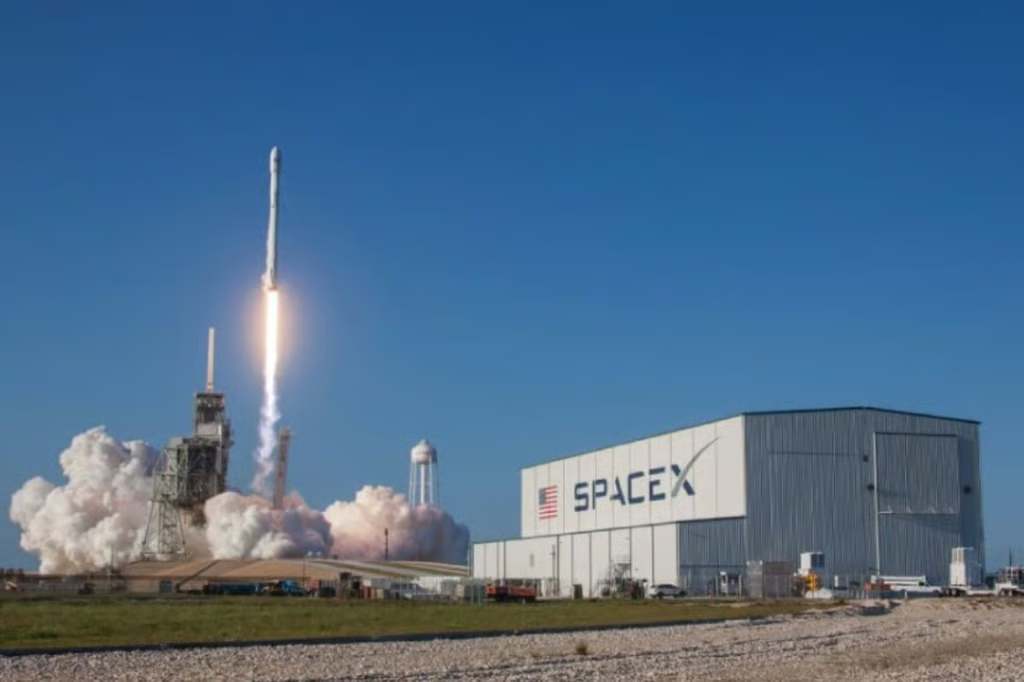
Wall Street just put a $1.77 trillion price tag on Elon Musk’s vision of the future.
SpaceX raised $75 billion after pricing its historic IPO at $135 per share, making it the largest public offering ever and one of the biggest corporate fundraising events in modern history. The deal gives the company fresh capital as it expands Starlink, advances Starship, and deepens its presence in government and defense programs.
The scale of the valuation speaks to how investors increasingly view the company. SpaceX is no longer being assessed solely on its ability to launch rockets but on its potential to become a foundational provider of communications, transportation, and strategic infrastructure.
That distinction may ultimately matter more than the IPO itself. Investors are backing a vision that extends far beyond today’s business and into markets that do not yet fully exist.
Inside the biggest IPO in history
When Elon Musk surpassed the $700 billion net worth milestone, he became the first person to do so. Now his company has just helped him set another record.
The listing follows years of speculation over when Musk would take the company public. Until now, SpaceX had largely relied on private fundraising rounds and share sales that steadily pushed its valuation higher, making it one of the world’s most valuable private companies.
According to Reuters, the scale of the IPO helped the company surpass Saudi Aramco’s 2019 IPO. The IPO also placed SpaceX among corporate heavyweights such as Meta and JPMorgan Chase. The company is expected to begin trading its stocks on Friday, giving public investors their first opportunity to buy shares directly. Musk retains 82% control of the company.
Why investors see more than a space company
SpaceX’s valuation is difficult to explain through rocket launches alone. While the company remains the dominant player in commercial space transportation, investors increasingly view it as a business that sits at the intersection of telecommunications, defense, artificial intelligence, and space infrastructure.
A major part of that story is Starlink, the company’s internet satellite arm. Unlike rocket launches and defense contracts, which generate revenue on a project-by-project basis, Starlink offers recurring subscription income while positioning SpaceX as an international connectivity provider with millions of users.
The company has also become deeply embedded in government and military operations through partnered satellite deployments and defense contracts. Those relationships have helped strengthen the perception that SpaceX is evolving into a globally relevant provider rather than a traditional aerospace firm. And on Wall Street, perception is powerful.
In parallel, investors are betting on technologies that have yet to mature fully. Starship, SpaceX’s next-generation spacecraft and rocket system, is expected to underpin the company’s bold ambitions. Artificial intelligence, on the other hand, is expected to be plugged into all its operations while improving autonomous systems.
What's hot at TechRepublic
- Blackpoint Cyber vs. Arctic Wolf: Which MDR Solution is Right for You?
- Why AWS Sellers Choose Deepgram Over Other Voice AI Tools
- SS&C Intralinks DealCentre AI vs. Datasite: Which platform is built for the future of dealmaking?
- SS&C Intralinks FundCentre AI vs. Juniper Square: Which platform better supports modern private markets fund managers?
- Verito vs. Rightworks: Which IT Provider Is Best for Your Firm?
Well, not everyone is convinced
Critics argue that such a valuation is overstated, and that much of the company’s future value is tied to projects whose commercial potential hasn’t been fully proven.
The IPO has also attracted scrutiny from policymakers. According to CNBC, Senator Elizabeth Warren has questioned index providers about the adjustments made to accommodate the company’s IPO, raising concerns about transparency and governance.
Whether SpaceX ultimately reaches this valuation or not, the IPO signals a broader shift in how investors view the future. Instead of rewarding companies focused on a single market, investors appear to be placing their biggest bets on firms that solve interconnected problems under one roof. And SpaceX has become one of the clearest examples of that trend.
For more on SpaceX’s growing role beyond spaceflight, check out its recent AI infrastructure partnership with Google.