


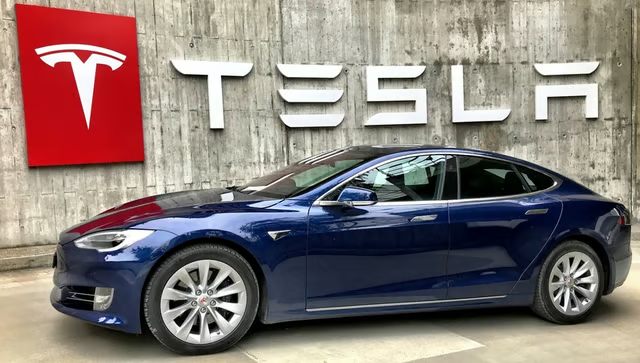
Tesla’s vehicle business is showing signs of improvement, but one strong quarter does not yet amount to a full recovery.
The company delivered 486,532 vehicles in the third quarter, beating analysts’ average estimate of roughly 461,000. Deliveries rose 1.3% from the second quarter but remained about 2% below the 497,099 vehicles Tesla delivered a year earlier.
The result was enough to lift Tesla shares about 5% in early trading Friday, although the stock remained down more than 20% for the year. Tesla produced 464,391 vehicles during the quarter, about 22,000 fewer than it delivered.
That suggests the company reduced some existing inventory to meet demand. The Model 3 and Model Y remained the backbone of the business, accounting for 478,237 deliveries, or about 98% of the total.
Europe is giving Tesla a lift
Europe has become one of the clearest signs of improvement after a difficult 2025.
Registrations across the EU, Britain and EFTA rose 43.3% from January through August, according to The Next Web, citing European Automobile Manufacturers’ Association data. Reuters said EU registrations increased by about two-thirds over the same period.
September also brought strong gains in markets including France, Portugal, Sweden and Spain. This rebound is significant because Tesla is showing it can grow in at least one major market without relying on the US federal EV tax credit, which expired in September 2025.
At the same time, Chinese automakers such as BYD are putting more pressure on Tesla with lower-priced electric vehicles.
The numbers are encouraging, but not a reset
Tesla still needs 311,448 deliveries in the fourth quarter to surpass its 2025 total, Reuters reported. Analysts have raised their 2026 delivery forecast to 1.82 million from 1.65 million in June.
But the delivery beat alone does not prove Tesla has returned to durable growth. Deliveries remain below last year, the company is heavily dependent on two aging high-volume models, and its US and China businesses continue to face pressure.
There is also a more important question for investors: whether Tesla can turn stronger deliveries into stronger financial performance. That answer will become clearer when Tesla reports third-quarter earnings on Oct. 21. The company’s ability to maintain margins while using pricing, inventory and incentives to support demand could matter more than the headline delivery number.
What Tesla’s next phase looks like
The delivery rebound gives Tesla some breathing room as CEO Elon Musk pushes the company toward robotaxis, Full Self-Driving and humanoid robots.
Morningstar analyst Seth Goldstein said, “The strong numbers put Tesla on track for full-year deliveries growth following two years of declines. I point to FSD (Full Self-Driving) as being a differentiator that drives consumers to choose Tesla over other autos,” according to Reuters.
Tesla also deployed 13.7 gigawatt-hours of energy storage during the quarter, up from 12.5 GWh a year earlier, providing another growing business outside its automotive operations.
Still, the company’s enormous valuation increasingly depends on businesses that have yet to reach the scale of its car operation. Robotaxis and Optimus could eventually change Tesla’s growth profile, but their commercial success depends on technology, regulation, manufacturing and consumer adoption.
What's hot at TechRepublic
- Blackpoint Cyber vs. Arctic Wolf: Which MDR Solution is Right for You?
- Why AWS Sellers Choose Deepgram Over Other Voice AI Tools
- SS&C Intralinks DealCentre AI vs. Datasite: Which platform is built for the future of dealmaking?
- SS&C Intralinks FundCentre AI vs. Juniper Square: Which platform better supports modern private markets fund managers?
- Verito vs. Rightworks: Which IT Provider Is Best for Your Firm?
What Tesla’s results mean for drivers and buyers
For consumers, the latest results suggest Tesla remains a significant player in an increasingly competitive EV market, but they do not guarantee cheaper vehicles or better ownership economics.
The Model 3 and Model Y still dominate Tesla’s lineup, so buyers waiting for a broader range of mainstream vehicles may see limited change in the near term. Meanwhile, competition from BYD and other EV makers continues to expand the number of alternatives available in major markets.
The more immediate question is whether Tesla can sustain stronger demand without sacrificing profitability. Its Oct. 21 earnings report should provide the clearest indication yet of whether the latest delivery improvement marks the start of a durable recovery.
Other news: Metaview raised $60 million to expand its AI recruiting platform, including autonomous agents that can source candidates, conduct screening tasks, handle outreach, and schedule interviews.