


Thailand’s data center boom is moving faster than its rules.
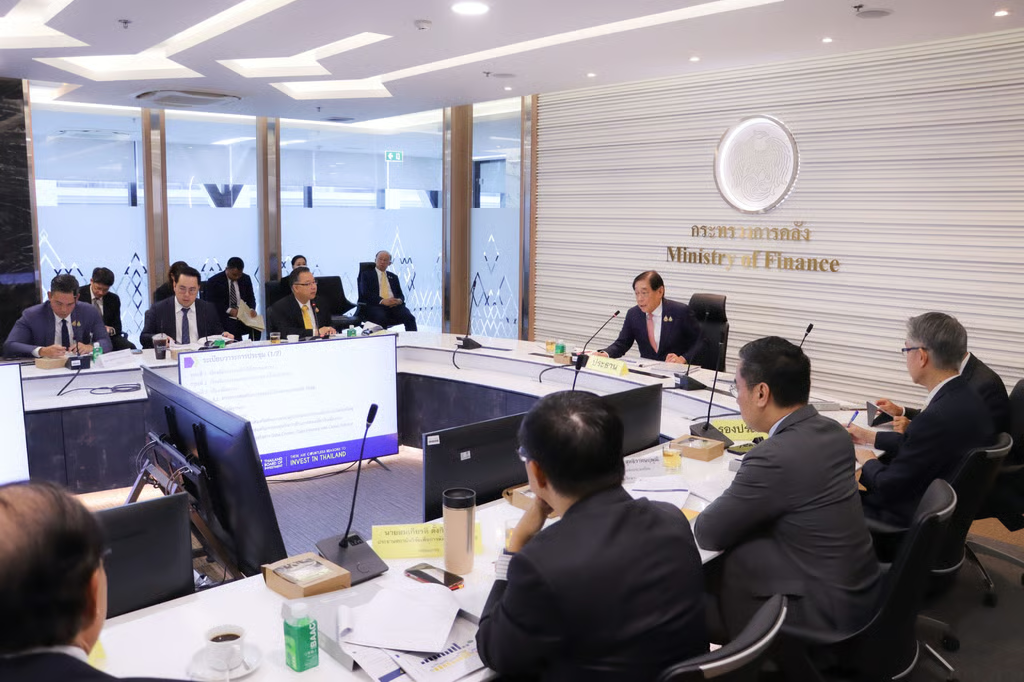
The government has asked operators of 49 data centers already under construction to voluntarily pause work while separately holding approval decisions for more than 117 projects awaiting permission. The Sept. 4 review gives regulators a month to draft nationwide standards covering electricity, water, safety, location, and environmental requirements.
Thailand cannot currently compel the 49 projects to stop construction, but government agencies can withhold permissions from projects still awaiting approval.
Thailand widens scrutiny as projects multiply
Danucha Pichayanan, secretary-general of Thailand’s National Economic and Social Development Council, told AFP that authorities currently lack the power to order the 49 projects to stop. Developers have instead been asked to cooperate voluntarily while the new framework is developed.
More than 117 projects awaiting permission or consideration by government agencies have had approval decisions put on hold. Combined with the projects under construction, about 166 developments are affected by the review, according to details from the Sept. 4 meeting.
Officials also identified 35 operating data center projects or companies after gathering information from 16 agencies. They said the records lacked enough detail for effective regulation and monitoring.
Four subcommittees have until early October to propose criteria covering economic benefits, infrastructure and clean energy, site and building safety, and environmental practices. Officials are considering electricity and water requirements, resource-use fees, utility pricing, town planning, backup power, and environmental safeguards.
A proposed 2-megawatt threshold for treating data centers as industrial operations was sent back for further study. No final threshold, tariff, or resource-use fee has been announced.
Thailand’s review comes as other APAC markets confront the same infrastructure constraints. In Malaysi, Johor’s data center pipeline has surged even as grid capacity, water demand, and immediately available colocation space remain tight. Australia’s energy operator has also warned that AI data centers could pressure grid stability if large new loads connect without enough coordination.
The pressure extends to how facilities are operated. At the Open Compute Project’s APAC Summit in August, operators were already focusing on power, cooling, and fleet-scale infrastructure management as AI systems drive denser deployments.
Thailand’s review reaches projects already under construction
The Sept. 4 action expands a regulatory slowdown that began months earlier. Thailand’s Board of Investment had already stopped approving new data center projects in April 2026 as the government worked to close gaps in a fragmented oversight system.
The intervention follows a steep rise in investment. Digital-sector investment applications reached about 1.12 trillion baht in the first half of 2026, compared with 522.6 billion baht in the first half of 2025, according to Board of Investment figures. The sector therefore more than doubled year over year.
For enterprises, the immediate risk is uncertainty over future capacity, utility costs, and project schedules rather than a nationwide construction shutdown. Proposed criteria are due in early October, but that drafting deadline does not guarantee affected projects will immediately resume.
Until those rules are published, Thailand’s data center pipeline will remain a growth market with more uncertainty around power, water, and project delivery.
Read more: Regional capacity is expanding at the same time: the Philippines recently set out a plan to scale AI data center capacity to 1.5 GW by 2033, adding another variable for companies weighing where to place future APAC workloads.
Let us teach you How to Talk to AI for free! Try our six-minute course at The Neuron Academy and learn a few simple ways to write better prompts and get more useful results from AI, or browse our other AI course for free for seven days. Check out all the lessons here →