
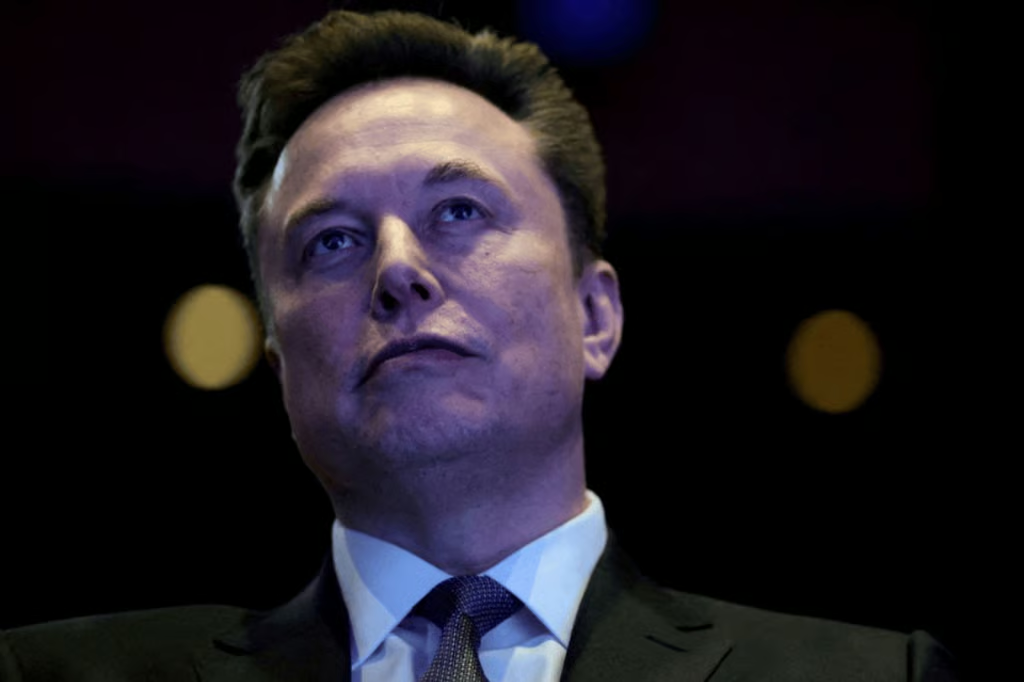


Iranian state media announced Thursday that the Islamic Republic plans to designate all of Elon Musk’s regional corporate assets as official military targets, escalating tensions just as the billionaire’s space venture prepares for a massive Wall Street debut.
The state-run Fars News Agency, which has ties to Iran’s Revolutionary Guard, reported that Tehran is adding “all interests related to economic holdings managed by Elon Musk in West Asia” to its military target bank.
According to reports from Fars, the broadened target list includes physical Starlink ground facilities across the region, specifically citing infrastructure in Israel, Jordan, Qatar, the United Arab Emirates, and Oman, as well as various SpaceX regional partners and Musk’s social media platform, X.
The rationale behind the threats stems from allegations of corporate complicity in regional warfare. Citing an unnamed “informed source,” Fars reported that Iran accuses the US military of leveraging Musk-linked companies to commit war crimes, including alleged attacks targeting water infrastructure in southern Iran earlier this week.
“The Islamic Republic of Iran reserves the right to attack all facilities related to [Musk]-managed holdings in the region and occupied territories,” the source told Fars.
This is not the first time Tehran has trained its sights on Silicon Valley. In March, the Islamic Revolutionary Guard Corps issued threats to target more than 18 high-profile American tech, artificial intelligence, and logistics firms, including Nvidia, Apple, Microsoft, Google, Meta, and Musk’s own Tesla.
What's hot at TechRepublic
- Blackpoint Cyber vs. Arctic Wolf: Which MDR Solution is Right for You?
- Why AWS Sellers Choose Deepgram Over Other Voice AI Tools
- SS&C Intralinks DealCentre AI vs. Datasite: Which platform is built for the future of dealmaking?
- SS&C Intralinks FundCentre AI vs. Juniper Square: Which platform better supports modern private markets fund managers?
- Verito vs. Rightworks: Which IT Provider Is Best for Your Firm?
Geopolitical whiplash and a trillion-dollar eve
The aggressive rhetoric from Iranian state media coincided with a day of volatile, high-stakes digital diplomacy from the White House.
Early Thursday, President Donald Trump sparked global concern by posting on social media that the US military would strike Iran “VERY HARD TONIGHT,” threatening that American forces would soon “be taking Kharg Island,” along with other vital oil infrastructure. The threat followed days of tit-for-tat military actions, initiated after Trump accused Iran of downing a US Army helicopter over the Strait of Hormuz on Monday.
However, hours after the initial warning, Trump dialed back the rhetoric, announcing on Truth Social that he had canceled the planned strikes because discussions had reached “the highest level of Iranian leadership” and a tentative peace deal had been reached.
The geopolitical storm comes at a hyper-critical financial moment for Musk. SpaceX is scheduled to go public on Friday at an estimated valuation between $1.75 trillion and $2 trillion. According to Forbes, Musk’s personal net worth currently hovers around $781.7 billion to $784.8 billion, meaning a successful market debut could officially solidify his status as the world’s very first trillionaire.
Related reading: A broader look at Musk’s growing industrial footprint can be found in our coverage of the proposed Texas “Terafab” chip plant, a project that could deepen his influence over the AI and semiconductor supply chain.