
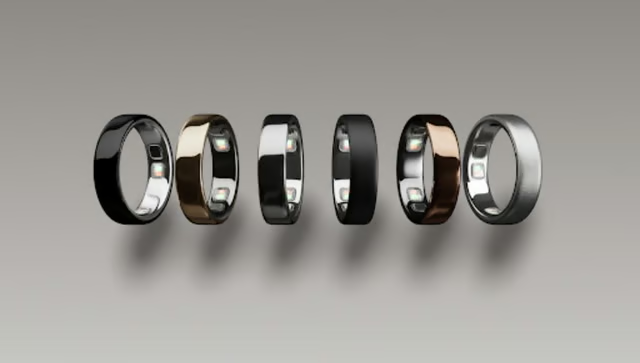


Oura is taking its smart-ring business to Wall Street.
The company has launched a U.S. initial public offering of 50 million shares priced between $40 and $44 each, putting the deal at up to $2.2 billion. Oura itself plans to sell 13.5 million shares, while existing shareholders will sell another 36.5 million. The selling stockholders also intend to give underwriters a 30-day option to purchase another 7.5 million shares.
Oura has applied to list on the Nasdaq Global Select Market under the ticker “OURA.” The IPO is expected to price Sept. 29, according to Bloomberg.
At the top of the proposed range, Oura would have a market value of about $14.1 billion based on outstanding shares, while its fully diluted valuation would be about $15 billion, Bloomberg reported. Reuters, meanwhile, put the fully diluted valuation at $15.62 billion.
That would represent a substantial increase from Oura’s roughly $11 billion valuation following its 2025 funding round.
The IPO will test whether public investors see Oura as more than a hardware company. Its business increasingly depends on both ring sales and recurring membership revenue tied to health and wellness data.
Growth is coming from rings and memberships
Oura has sold about 3.6 million rings in the 12 months ended June 30, according to its IPO filing. Revenue reached $1.21 billion during the first nine months of the year, up about 74% from $697.6 million a year earlier.
The company expects to finish fiscal 2026 with about 5.7 million paid members, a 96% year-over-year increase. Oura attributed the growth primarily to strong sales of its Oura Ring 5.
Its membership service costs $5.99 per month or $69.99 annually in the U.S. and provides access to more than 50 health metrics and personalized insights. The filing shows membership revenue more than doubled to $240.5 million and carried an 89% gross margin during the period.
Most IPO money will go to existing investors
The offering’s structure is notable because existing shareholders are selling nearly two-thirds of the shares. At a $42 midpoint, TechCrunch estimates those investors would receive about $1.53 billion before fees and expenses, compared with roughly $567 million for Oura.
Oura expects about $526.4 million of its IPO proceeds to cover tax obligations connected to employee stock grants that vest when the company goes public. That would leave roughly $6.2 million for general corporate purposes. Forerunner Ventures, which owns 9.3% of Oura, plans to sell its entire stake, according to the filing.
What the listing says about wearables
Oura’s public-market debut puts a business built around both hardware and recurring subscriptions under investor scrutiny.
The company has positioned its screen-free ring as a smaller alternative to smartwatches, while its membership service turns health tracking into an ongoing revenue stream rather than a one-time hardware sale.
That combination gives Oura two connected sources of growth, but it also raises the bar for execution. Investors will be watching whether strong ring sales continue to translate into sustained membership growth and whether Oura can keep expanding recurring revenue without slowing demand for the hardware itself.
What's hot at TechRepublic
- Blackpoint Cyber vs. Arctic Wolf: Which MDR Solution is Right for You?
- Why AWS Sellers Choose Deepgram Over Other Voice AI Tools
- SS&C Intralinks DealCentre AI vs. Datasite: Which platform is built for the future of dealmaking?
- SS&C Intralinks FundCentre AI vs. Juniper Square: Which platform better supports modern private markets fund managers?
- Verito vs. Rightworks: Which IT Provider Is Best for Your Firm?
What this means for Oura users
The functionality of Oura Ring products and Oura Membership remains unchanged for consumers following the IPO. Users retain access to their personal health and wellness metrics via the Oura app and its Advisor AI feature, while the company continues to offer its subscription service alongside the Ring 5.
However, the transition to a public listing subjects Oura’s financial expansion and recurring revenue model to heightened investor review. Additionally, a proposed class-action lawsuit claims the device fails to track sleep stages with the degree of accuracy advertised in its marketing. Oura denies these allegations and intends to fight the suit.
That makes the IPO about more than a popular wearable becoming a publicly traded stock: Oura is asking investors to value a business whose future depends on consumers continuing to pay for increasingly sophisticated health insights.
For users, the bigger shift is not an immediate product change but the incentives surrounding the company. Oura is asking investors to value it not just as a maker of smart rings, but as a health platform built on customers continuing to pay for increasingly detailed insights over time.
Other news: A mysterious Google wearable identified as G8BL6 has surfaced in regulatory filings with Bluetooth and GPS, fueling speculation that Google could be preparing a new fitness tracker to sit between Fitbit devices and the Pixel Watch.