
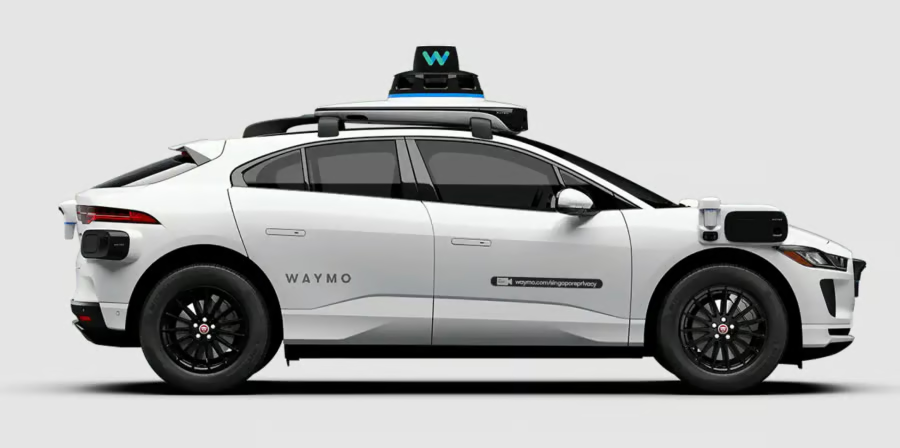


Waymo is taking its robotaxi ambitions to Singapore, giving Southeast Asia its first planned Waymo market and the company a new test of whether its U.S.-built autonomous-driving system can adapt to very different roads and weather.
Alphabet’s self-driving unit plans to begin fully autonomous, all-electric ride-hailing in Singapore in 2028, subject to regulatory approval. Before then, Waymo will spend 2027 mapping roads and adapting the Waymo Driver to local traffic patterns, road geometry, and monsoon conditions.
The expansion puts Asia at the center of Waymo’s next international phase. The company is also preparing to enter Tokyo in 2027, making Singapore another important test of how well its technology travels beyond U.S. cities.
How Waymo’s Singapore rollout will work
Waymo is partnering with Singapore’s Ministry of Transport and Land Transport Authority. According to Reuters, its first Jaguar I-PACE vehicles are expected to arrive in the coming months as the company establishes local operations.
The rollout will happen in stages:
- Coming months: Waymo’s first electric vehicles will arrive in Singapore.
- 2027: Trained specialists will manually drive them while Waymo maps local roads and adapts its system to Singapore conditions.
- 2028: Fully autonomous public rides are expected to begin, pending regulatory approval.
CNA noted that testing will start in western Singapore around Labrador and Harbourfront, with potential uses including work commutes, weekend trips, and service to industrial areas with fewer transport options. The government sees autonomous vehicles as a supplement to trains, buses, taxis, and private-hire cars, particularly after public transport hours or in areas drivers may be less willing to serve.
Waymo enters an already crowded Singapore AV market
Waymo will not have Singapore to itself.
Grab and Chinese autonomous-driving company WeRide already operate community AV rides in Punggol, while Grab plans to expand its autonomous fleet from 10 to 50 vehicles. Fortune also reported partnerships involving WeRide and Pony AI, adding US-Chinese competition to Singapore’s growing autonomous-vehicle market.
Singapore also gives Waymo a chance to prove that experience accumulated in US cities can transfer to a different climate, road network, and regulatory system. Waymo says its Driver uses lidar, cameras, and radar for a 360-degree view and has logged more than 300 million kilometres on public roads.
The company also reports 94% fewer injury-causing crashes than human drivers covering the same distance in the US cities where it operates. Waymo’s US figure does not guarantee similar results in Singapore, where its system must still adapt to local road layouts, monsoon conditions, and traffic patterns.
More must-read AI coverage
- SS&C Intralinks DealCentre AI vs. Datasite: Which platform is built for the future of dealmaking?
- SS&C Intralinks FundCentre AI vs. Juniper Square: Which platform better supports modern private markets fund managers?
- Why Data, Not Models, Determines AI Success
- The Rise of the AI-Native Factory: How Physical AI Is Transforming Manufacturing
Robotaxis will add jobs as well as automation
Singapore will give Waymo a long runway to prove that its autonomous-driving system can adapt beyond the U.S. before public rides begin in 2028.
The market also offers something broader: a tightly regulated test environment where Waymo, Grab, WeRide, and other autonomous-driving companies can be measured against the same roads, weather, and transport expectations.
If the rollout succeeds, Singapore could become an important reference point for how robotaxi services expand across the rest of Southeast Asia.
For more on how robotaxi services are rolling out in other markets, see how Uber and Wayve launched the UK’s first supervised robotaxi rides in London with 15 electric vehicles.