


Apple is caught between a memory shortage squeezing its costs and a U.S. government pushing it away from cheaper Chinese supply.
U.S. Commerce Secretary Howard Lutnick has told Apple directly that the Trump administration opposes the company buying memory chips from Chinese manufacturers as Apple searches for ways to deal with a global supply crunch.
According to The Wall Street Journal, Lutnick said there have to be “other solutions to the memory issue, but it’s not great American companies using Chinese memory.” When asked whether he had delivered that message to Apple, he replied, “plainly.”
The AI boom has data centers gobbling up memory chips faster than manufacturers can make them, and prices have spiked as a result. Apple and other electronics makers have been raising prices to cope. Looking for relief, Apple has been testing memory from two Chinese firms, CXMT and Yangtze Memory Technologies (YMTC), as a possible fix.
Apple hasn’t confirmed the testing outright. COO Sabih Khan, according to the Journal, said that given the size of the shortage, “we have to look at all options.” He also noted that unlike most iPhone parts, “there isn’t a lot of customization” for memory — meaning Apple could plausibly use off-the-shelf Chinese chips without tripping export-control rules that only kick in when sharing custom design specs.
Pressure from US chipmakers
The issue has also become a battleground for American semiconductor interests.
Idaho-based Micron Technology has urged the Trump administration to block Apple from using Chinese memory, arguing that doing so could hurt U.S. semiconductor production and undermine efforts to bring manufacturing back to America, the Journal reported.
Senators from New York, Indiana and Idaho also wrote to Apple CEO Tim Cook in late July, urging the company not to work with Chinese memory manufacturers.
YMTC is on the Commerce Department’s Entity List, while the Pentagon has designated both YMTC and CXMT as Chinese military companies. Those designations raise national security concerns but do not, by themselves, prohibit Apple from buying commercially available memory.
The dispute creates a tricky choice for Apple. Chinese memory could give the company another source during a severe shortage, potentially helping control component costs. But relying on Chinese suppliers could increase regulatory and geopolitical risks while clashing with Washington’s push to expand U.S. semiconductor manufacturing.
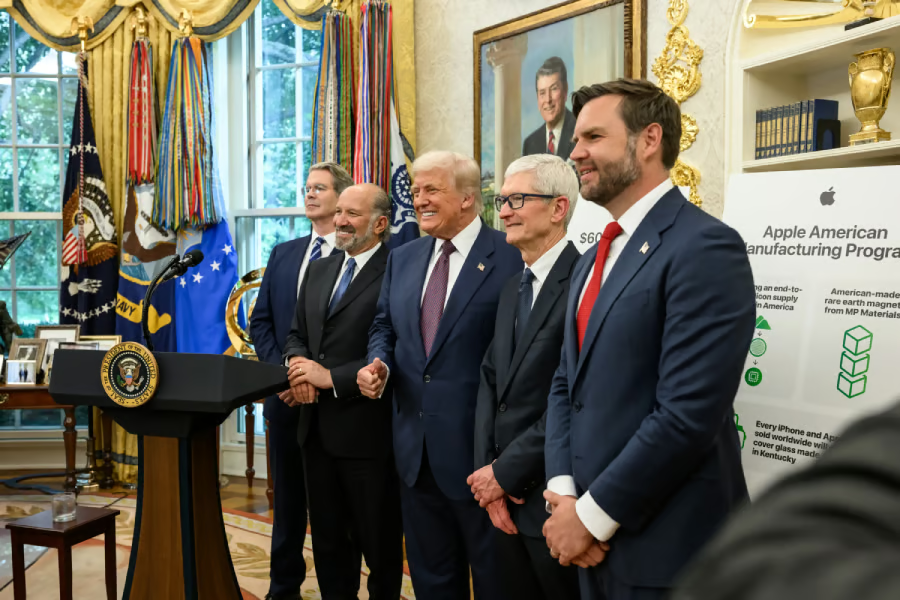
Apple has already made domestic manufacturing commitments, including spending tens of billions of dollars on U.S.-made chips for iPhones and adding Mac Mini production in Texas. The administration has also secured an arrangement for Intel to make some Apple chips and an Apple commitment to manufacture iPhone and Apple Watch cover glass in the U.S.
Still, most of Apple’s supply chain remains concentrated in Asia, while the company continues expanding iPhone assembly in India.
Must-read Apple coverage
- Nearly 7 in 10 iPhone Owners Plan iPhone 17 Upgrade
- Apple Prepares AI-Powered Siri Upgrade With Google Search Integration
- Apple’s Xcode 26 Beta Now Supports GPT-5 and Claude
- Apple’s Vision Pro Adoption Stalled As Content Released ‘Drip by Drip’
The bigger supply-chain problem
The immediate problem is that reshoring cannot quickly solve a global memory shortage. Semiconductor capacity takes time to build, leaving companies like Apple to balance price, supply availability, and geopolitical risk in the meantime.
Chinese suppliers could give Apple more flexibility and potentially lower component costs, but using them would deepen tensions with Washington and U.S. chipmakers. Sticking with non-Chinese suppliers may reduce political risk while leaving Apple with fewer sourcing options during a constrained market.
Lutnick said the administration will keep pressing Apple to move more manufacturing to the U.S., but political pressure is not the same as a legal ban. For now, Apple’s memory decision sits in that gray area: Washington may not be able to simply forbid the purchases under existing rules, but it can make choosing Chinese suppliers increasingly difficult.
More News: The White House is pushing for safety reviews of OpenAI models as policymakers weigh how to manage the risks of widely available systems.