
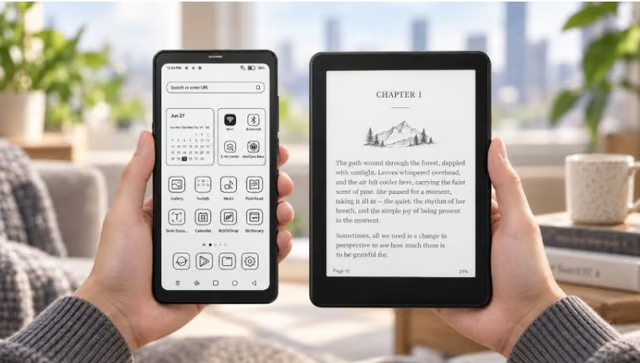


The Kindle Paperwhite is built to do one thing particularly well: let you read for weeks without thinking much about the device itself. The new Boox Palma 3 takes almost the opposite approach, squeezing Android apps, expandable storage, a camera, and optional stylus support into a pocket-sized E Ink device.
BOOX unveiled the Palma 3 this week with a 6.13-inch E Ink display, Android 16, Google Play access, 128GB of storage, and a price of roughly $320. Amazon’s 7-inch Kindle Paperwhite costs $199.99.
That leaves buyers with a roughly $120 question: Is the Palma 3’s added flexibility worth paying more for, or is the cheaper Paperwhite still the better fit if reading is the priority?
What the Palma 3 can do that a Kindle can’t
The Palma 3 behaves more like a pocket-sized Android device than a conventional ebook reader. It runs Android 16 with access to the Google Play Store, so readers can install different reading, news, cloud storage, and productivity apps instead of depending mainly on one ebook ecosystem. Engadget also reported a 3,950mAh battery and support for the optional $46 InkSense Plus stylus.
BOOX also redesigned the hardware. Mashable said that the Palma 3 swaps the previous model’s plastic frame for aluminum and adds a paper-textured fiberglass back. Its 16MP rear camera can scan documents, while dual microphones support voice memos and speech-to-text, giving the device uses that extend beyond ebooks.
The Palma 3 packs 6GB of RAM and 128GB of internal storage, with a microSD slot for expansion. BOOX also includes fingerprint recognition, physical page-turn and volume buttons, and a customizable smart button. At about 195 grams and 159mm tall, its narrow proportions are closer to a large smartphone than a traditional e-reader.
The Kindle Paperwhite keeps its focus squarely on comfortable, long-form reading. Amazon currently lists the model with a 7-inch, 300-ppi display, 16GB of storage, adjustable warm lighting, dark mode, USB-C charging, IPX8 waterproofing, and up to 12 weeks of battery life.
The larger screen gives books more breathing room, while waterproofing makes it easier to bring the Paperwhite to the pool, beach, or bath.
| Display | 6.13-inch, 300 ppi | 7-inch, 300 ppi |
| Software | Android 16 + Google Play | Kindle platform |
| Storage | 128GB + microSD | 16GB |
| Third-party apps | Yes | Limited |
| Page-turn buttons | Yes | No |
| Stylus support | Optional InkSense Plus | No |
| Camera | 16MP rear camera | No |
| Water resistance | No IP rating listed | IPX8 |
| Weight | Approx. 195g | Approx. 211g |
| Battery | 3,950mAh | Up to 12 weeks |
| Price | About $320 | $199.99 |
The trade-off is screen size and simplicity versus flexibility. The Palma 3 gives up some reading space for a narrower, more pocketable body while adding Android apps, expandable storage, physical controls, handwriting support, and document-scanning tools.
The Paperwhite goes in the other direction. Its larger display, waterproofing, and stripped-down software make it less versatile but more purpose-built for long reading sessions.
What's hot at TechRepublic
- Blackpoint Cyber vs. Arctic Wolf: Which MDR Solution is Right for You?
- Why AWS Sellers Choose Deepgram Over Other Voice AI Tools
- SS&C Intralinks DealCentre AI vs. Datasite: Which platform is built for the future of dealmaking?
- SS&C Intralinks FundCentre AI vs. Juniper Square: Which platform better supports modern private markets fund managers?
- Verito vs. Rightworks: Which IT Provider Is Best for Your Firm?
Is the Palma 3 worth paying $120 more?
The Palma 3 makes the most sense for readers who regularly move among different ebook services, documents, news apps, or cloud tools. Google Play access lets it handle much more than books, while its narrower design makes it easier to carry than a traditional e-reader.
The Paperwhite makes a different value case. Amazon raised the 16GB model’s price from $159.99 to $199.99 in August, but it remains about $120 cheaper than the Palma 3. For that lower price, readers still get a larger 7-inch screen, IPX8 waterproofing, and battery life measured in weeks.
The extra cost of the Palma 3 therefore comes down to how much those additional capabilities matter. Its Android apps, expandable storage, physical controls, camera, microphones, and optional stylus give it more room to double as a lightweight mobile device. The Paperwhite is more purpose-built, prioritizing a larger reading surface, durability around water, and fewer distractions.
So, does the Palma 3 beat the Kindle Paperwhite?
For readers who want one compact E Ink device for books, apps, documents, and notes, the Palma 3 offers considerably more flexibility. For readers who mainly want to read, the Paperwhite delivers the more straightforward experience at a substantially lower price.
The Palma 3 is also still new, so broader hands-on testing will be needed to judge its real-world battery life, responsiveness, stylus experience, and day-to-day Android performance. On specifications alone, BOOX gives buyers more ways to use an E Ink device, but whether those extras justify the higher price depends on how far beyond reading they plan to go.
Looking beyond Kindle? Check out our best Kindle alternatives for 2026 for more e-readers with different apps, formats, features, and price points.