
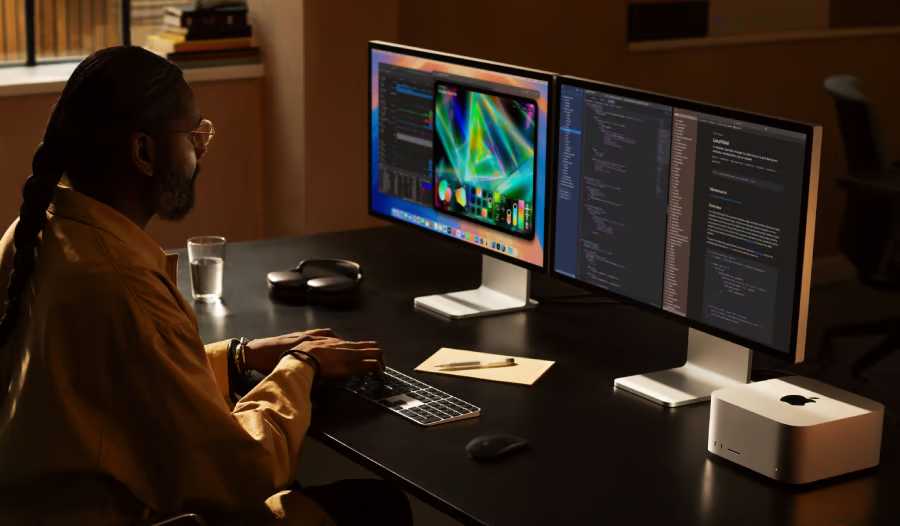


Mac Studio was supposed to fill a gap in Apple’s desktop lineup. Instead, it may have become the new center of gravity for professional Mac users.
Apple’s compact desktop has grown from a specialized machine for video editors and creative teams into a serious option for developers, AI researchers, engineers, and businesses that need workstation-class performance without a traditional tower. Recent shipping delays for high-end M3 Ultra configurations suggest demand has caught up with that shift.
That makes Mac Studio more than another premium Apple product. It shows how professional computing is moving toward smaller, quieter, high-memory machines built for media, software development, and local AI workloads.
What is Mac Studio?
Mac Studio is Apple’s compact professional desktop, positioned above Mac mini and below the company’s most specialized workstation offerings.
Apple introduced Mac Studio in 2022 with M1 Max and M1 Ultra chips. The latest generation includes M4 Max and M3 Ultra configurations, Thunderbolt 5 connectivity, support for up to 512GB of unified memory, and up to 16TB of storage, according to Apple’s March 2025 announcement, which called the device “the most powerful Mac ever.”
The result is a machine built for demanding workloads, including software development, machine learning, video production, 3D rendering, scientific computing, and local AI experimentation.
Why professionals embraced Mac Studio
Mac Studio’s appeal starts with a simple promise: workstation-class performance without the usual workstation baggage.
For creative teams, that means a quiet desktop that can sit near cameras, microphones, storage drives, and production equipment. For developers, it means fast compilation times, large memory capacities, and enough power to support increasingly complex workflows. For IT leaders, it offers a standardized desktop platform that can be easier to deploy and manage than custom workstation builds.
The machine also benefits from Apple’s unified memory architecture, which allows the CPU, GPU, and Neural Engine to access a shared memory pool. That design can improve efficiency when working with large media projects, datasets, and AI workloads.
Apple positions Mac Studio as a desktop built to deliver pro-level performance in a dramatically smaller footprint than a traditional workstation tower.
AI gave Mac Studio a new purpose
Mac Studio was originally built for creative professionals. The AI boom gave it another audience.
As organizations increasingly experiment with local AI, demand has grown for machines with large memory pools that can run advanced models without relying entirely on cloud infrastructure. Developers can use local systems to prototype applications, test models, reduce cloud costs, and keep sensitive data closer to the device.
Apple highlighted this use case when announcing the latest Mac Studio, stating that M3 Ultra configurations can run large language models with more than 600 billion parameters entirely in memory. Independent testing has reinforced that message. TechRadar reported that a reviewer successfully ran the 671-billion-parameter DeepSeek R1 model on an M3 Ultra Mac Studio while consuming less than 200 watts.
That does not mean businesses are replacing GPU clusters with Mac Studios. However, it helps explain why the machine has become increasingly attractive to AI developers and technical teams.
Demand for Mac Studio is outpacing supply
The clearest sign of Mac Studio’s growing importance may be its availability.
In June 2026, Macworld reported that Apple’s highest-end M3 Ultra Mac Studio configurations were facing serious shipping delays. At the time, the publication found only a single M3 Ultra configuration available for purchase, while some systems showed delivery estimates stretching into October.
That is notable because Mac Studio is not a mass-market laptop or consumer desktop. The M3 Ultra model starts at $3,999 before upgrades, placing it firmly in workstation territory.
The shortages do not necessarily mean every Mac Studio configuration is selling equally well. Supply constraints, particularly around high-bandwidth memory, may also be contributing. But the situation highlights the increased demand for high-performance, AI-capable desktops.
For business buyers, the takeaway is straightforward: high-end Mac Studio configurations may now require procurement planning, especially when purchasing multiple units or supporting time-sensitive projects.
Must-read Apple coverage
- Nearly 7 in 10 iPhone Owners Plan iPhone 17 Upgrade
- Apple Prepares AI-Powered Siri Upgrade With Google Search Integration
- Apple’s Xcode 26 Beta Now Supports GPT-5 and Claude
- Apple’s Vision Pro Adoption Stalled As Content Released ‘Drip by Drip’
How Mac Studio changed the Mac Pro conversation
For years, Mac Pro represented Apple’s vision for professional desktop computing. It offered workstation-class performance, internal expansion, and support for highly specialized workflows.
Mac Studio changed that equation.
As Apple silicon improved, many users who once might have considered Mac Pro found they could get sufficient performance from a much smaller machine. Thunderbolt 5 further strengthened the case for external storage, displays, and expansion hardware, reducing the need for a traditional tower in many environments.
The latest Mac Studio configurations have also narrowed the performance gap between Apple’s professional desktop offerings, leading many buyers to question whether they need a larger workstation at all, as noted in The Verge’s launch coverage.
Mac Pro still serves users who require internal PCIe expansion and highly specialized hardware. But for many organizations, Mac Studio has become the more practical professional desktop.
Who should consider Mac Studio?
Mac Studio is overkill for most office workers, general business users, and basic creative workflows. A Mac mini, MacBook Air, or MacBook Pro will be a better fit for many people.
However, Mac Studio makes sense for organizations that need high sustained performance in a compact desktop. Common use cases include:
- Video production and post-production
- Software development
- Local AI experimentation
- Engineering and simulation workloads
- Data science and analytics
- Audio production
- 3D design and rendering
Its value extends beyond raw performance. The combination of power, size, efficiency, quiet operation, and integration with the broader Apple ecosystem has helped Mac Studio carve out a category of its own.
What comes next
Mac Studio’s future will likely depend on Apple’s chip roadmap, memory availability, and the continued growth of local AI workloads.
Reports already suggest Apple is working on future generations of the product, including models that could feature next-generation Ultra-class processors, according to Tom’s Guide.
For now, Mac Studio’s rise demonstrates how much the professional desktop has changed. The workstation no longer needs to be a large tower tucked under a desk. Increasingly, it can be a compact machine sitting on top of one.
What began as a gap between Mac mini and Mac Pro has become a category of its own. Judging by both demand and supply constraints, Apple may have created it at exactly the right time.
More Apple news: The tech giant is making headlines beyond hardware demand. Read our coverage of the newly disclosed USBLITER8 SecureROM exploit and its implications for Mac security.