
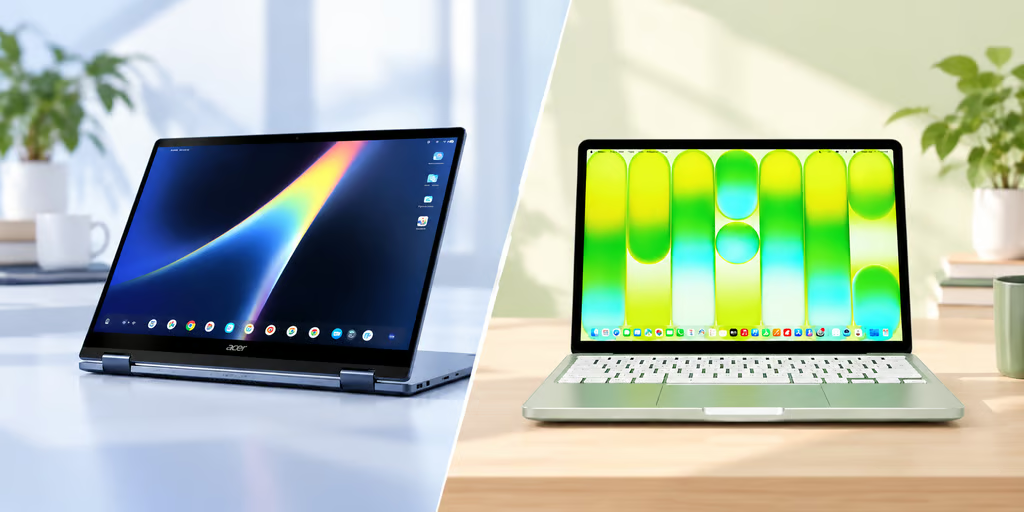


Picking between Googlebook and MacBook Neo is not just a choice between Google and Apple. One gives you more hardware options and deeper Android integration, while the other keeps things simpler with a familiar Mac setup.
MacBook Neo starts at $699, making it the cheaper option, while Googlebook models begin at $899 with more memory, more storage, and touchscreen choices. For everyday work, the better fit comes down to which apps and devices you already use.
- Googlebook vs MacBook Neo: Key differences
- MacBook Neo costs $200 less
- Googlebook gives buyers more hardware choices
- MacBook Neo has the more established desktop app ecosystem
- Android or iPhone may make the choice easier
- Battery claims are close, but Googlebook needs more testing
- Which laptop makes more sense for everyday work?
Googlebook vs MacBook Neo: Key differences
Googlebook is not one laptop with one fixed set of specs. Google created the platform, while Acer, ASUS, Dell, HP, and Lenovo each make their own Googlebook models with different processors, screen sizes, and designs. Google said all models start with at least 16GB of RAM, while some configurations offer up to 32GB.
MacBook Neo is much more standardized. Apple equips it with an A18 Pro chip, 8GB of unified memory, either 256GB or 512GB of storage, and a 13-inch Liquid Retina display with a 2408-by-1506 resolution and 500 nits of brightness.
| Feature | Googlebook | MacBook Neo |
|---|---|---|
| US starting price | $899 | $699 |
| Product type | Multiple models from PC makers | One Apple laptop |
| Memory | At least 16GB | 8GB unified memory |
| Base storage | 512GB standard across models | 256GB |
| Display | Touchscreen, varies by model | 13-inch Liquid Retina |
| Hardware makers | Acer, ASUS, Dell, HP, Lenovo | Apple |
| Phone ecosystem | Android | iPhone |
| AI | Gemini | Apple Intelligence |
| Availability | US stores Oct. 4 | Available now |
MacBook Neo costs $200 less
MacBook Neo currently starts at $699 in the US, while the first Googlebook models start at $899. That gives Apple a $200 advantage at the entry level.
Acer’s $899 Googlebook comes with an Intel Core Ultra 5 325 processor, 16GB of RAM, and a 512GB SSD. The starting configuration therefore offers twice the memory and twice the storage of the entry MacBook Neo.
For workers mainly handling email, browser tabs, documents, spreadsheets, and video calls, the question is whether those extra hardware resources are worth paying another $200.
Googlebook gives buyers more hardware choices
Googlebook offers more variety because five manufacturers are launching models. The Verge said that the first wave ranges from Acer’s convertible 2-in-1 to a lightweight ASUS model, Dell’s XPS Googlebook, an HP configuration with up to 1TB of storage, and Lenovo’s larger 15.3-inch model.
Acer’s entry model shows how different those options can get. It has a 14-inch OLED touchscreen with a 2880-by-1800 resolution, refresh rates up to 120Hz, stylus support, and a convertible form factor.
MacBook Neo takes the simpler route with one 13-inch clamshell design. Apple includes one USB 3 USB-C port, one USB 2 USB-C port, a headphone jack, and support for one external 4K display at 60Hz.
For buyers who want a touchscreen, convertible design, bigger screen, or more choice between manufacturers, Googlebook gives them more room to shop around. MacBook Neo makes the decision easier for someone who simply wants an inexpensive Mac.
MacBook Neo has the more established desktop app ecosystem
Googlebook is built on the Android technology stack with desktop foundations from ChromeOS. Google says the laptops can run native Android apps, access the Play Store, and use desktop-oriented tools including Adobe Photoshop, Lightroom, CapCut, and a Linux terminal environment.
MacBook Neo runs macOS, giving it access to the established Mac desktop software ecosystem alongside Apple Intelligence. Apple also includes productivity features such as iPhone Mirroring and Sidecar as part of macOS.
Workers should check that the Googlebook version of each required app has the features they use, especially before replacing a Mac or Windows work laptop. The Verge’s recent hands-on coverage noted that fully fledged desktop software remains one of the bigger questions around Google’s new platform, even though its Android app support is extensive.
Android or iPhone may make the choice easier
Googlebook is designed around Android phone integration. Its shared Android foundation supports features such as app casting, synchronized notifications, phone file access, and Continue On, which lets users move supported tasks between their phone and laptop.
Those integrations currently require Android 17 for some features, which means users with older phones may not immediately get the full experience.
MacBook Neo offers the corresponding advantage for iPhone users. macOS includes iPhone Mirroring, while Apple’s wider ecosystem lets users move between devices for messages, files, passwords, and other everyday tasks.
For people already heavily invested in Android or iPhone, that ecosystem connection may have a bigger impact on daily use than the difference between 8GB and 16GB of memory.
Battery claims are close, but Googlebook needs more testing
Google’s launch overview cites up to 14 hours of video playback and 16 hours of web browsing, though estimates differ by model. Because the lineup uses different processors and hardware designs, actual endurance will also vary between manufacturers.
Apple rates MacBook Neo for up to 16 hours of video streaming and 11 hours of wireless web use.
Those figures should not be treated as a direct battery-life win for either side because the companies use different testing methods. Googlebooks are also still in preorder as of late September 2026, so broader independent testing will give a clearer picture after the first devices reach US stores on Oct. 4.
Which laptop makes more sense for everyday work?
MacBook Neo has the lower starting price and gives buyers a familiar macOS environment for conventional desktop work. Its 8GB of memory and 256GB starting storage are less generous, but the $699 price makes those compromises easier to understand.
Googlebook starts $200 higher but gives buyers at least 16GB of RAM, more base storage, touchscreens, multiple hardware designs, Gemini features, and much tighter integration with Android phones.
For everyday work, choose MacBook Neo if your required apps run on macOS and the $200 lower starting price matters most. Consider a Googlebook if you use a compatible Android phone and need its extra memory, storage, or hardware choices. For a work rollout, check app and peripheral compatibility first; wait for independent Googlebook testing if battery life or performance will decide the purchase.
Read our comparison of Googlebook and Chromebook to see how Google’s new laptop platform differs from its ChromeOS lineup.